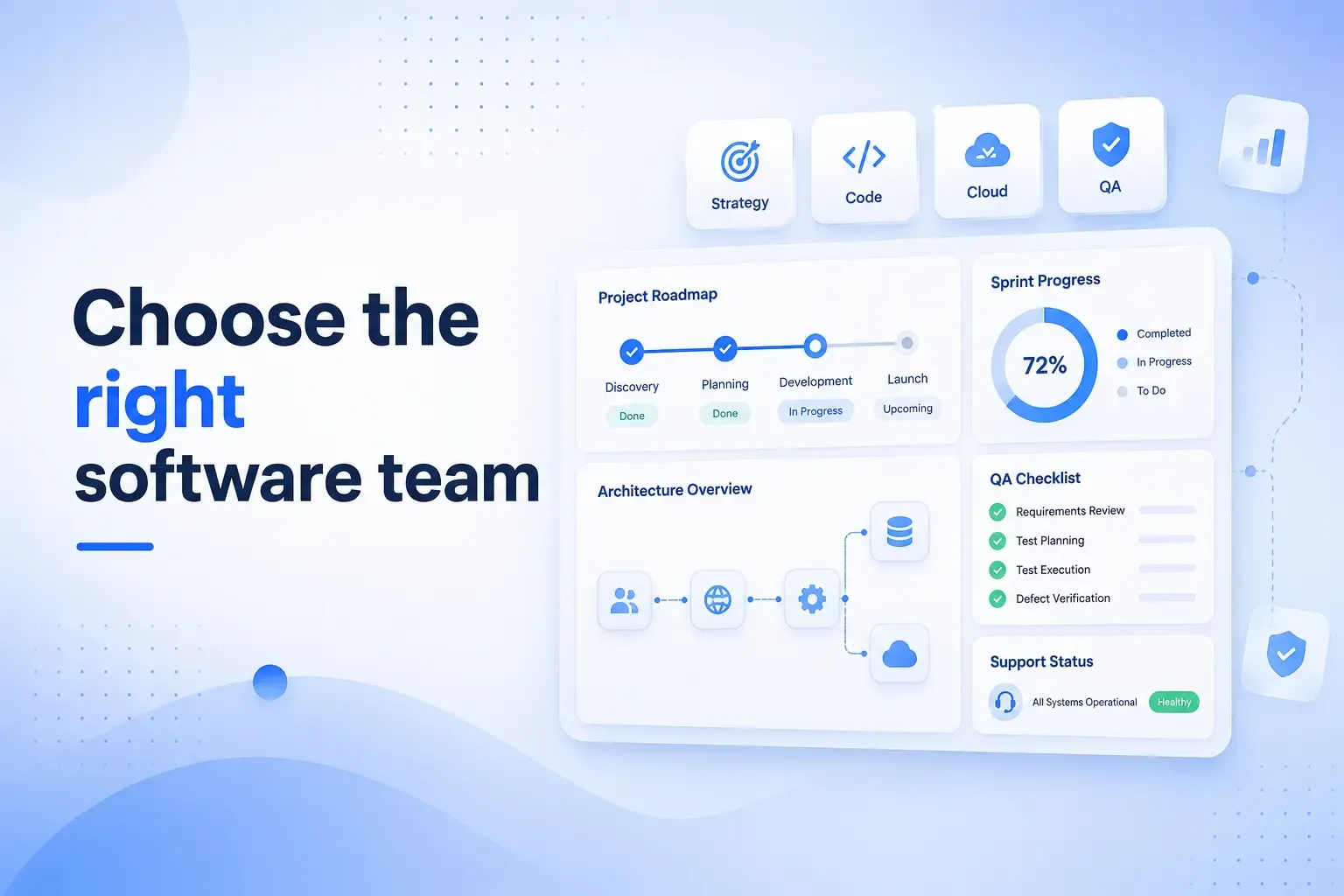
Choosing a software development company in Sri Lanka? Learn what to check before hiring, from discovery and architecture to delivery, ownership, and support.
Choosing a software development company in Sri Lanka is a high-stakes decision.
The right team can turn a messy internal process into a reliable business system. The wrong team can leave you with missed deadlines, unclear ownership, weak architecture, and software your team avoids using.
That risk is why the selection process matters. You are not just hiring developers. You are choosing the people who will understand your business logic, design the system, build it, test it, launch it, and support it after real users start depending on it.
Sri Lanka has strong software talent. The challenge is knowing which partner is right for your business.
This guide is for CEOs, CTOs, IT directors, operations leaders, and business teams comparing software companies in Sri Lanka. Here is what to check before you sign.
Start With the Business Problem
A serious software project should not begin with a technology preference. It should begin with the business problem.
Are you replacing spreadsheets? Automating approvals? Building a customer portal? Creating a SaaS product? Connecting branches, field teams, payments, inventory, finance, or reporting? Taking an existing system your team has outgrown and rebuilding it properly?
Each answer changes the project.
A good software development company should ask about users, workflows, exceptions, approvals, reporting, compliance, data ownership, and long-term support before recommending a stack or timeline.
If the first conversation jumps straight to screens and price, slow down. Software succeeds when the business logic is understood before the code starts.
Check Whether They Can Handle Discovery Properly
Discovery is where the project becomes clear.
This is the stage where the team maps your business process, user roles, data flows, third-party systems, edge cases, reporting needs, and risks. It protects your budget because it exposes assumptions early.
For a custom software project, discovery should usually cover:
- business goals and success measures
- user roles and permissions
- workflow steps and approval rules
- existing tools, spreadsheets, or legacy systems
- data migration needs
- integrations with finance, CRM, ERP, LMS, payment, or inventory systems
- reporting and dashboards
- security and access control
- hosting, backups, and support requirements
- phased delivery plan
If discovery feels rushed, the build will probably feel rushed too.
Look for Architecture Thinking, Not Just Coding
Software that works on day one can still become a problem six months later.
Architecture decides whether the system can scale, connect to other tools, support new features, and remain maintainable. This matters for any business system that will handle customers, staff, transactions, approvals, or sensitive data.
Ask potential software partners how they approach:
- data structure
- API design
- user permissions
- audit logs
- performance
- security
- testing
- hosting
- deployment
- future feature additions
You do not need to be technical to ask these questions. A credible team should be able to explain the approach in plain language and involve your IT team where needed.
Review Relevant Experience
A portfolio is useful, but relevance matters more than volume.
If you are building finance software, education software, retail operations tools, a SaaS platform, or an internal workflow system, look for projects with similar complexity. The exact industry match is helpful, but the deeper question is whether the team has solved comparable problems.
Ask for examples of:
- business systems with multiple user roles
- integrations with third-party tools
- mobile and web platforms working together
- data migration from old systems
- dashboards and reporting
- projects with post-launch support
- systems that improved operations, not just user interface design
Good software companies can explain what they built, why it mattered, and what changed for the client after launch.
Understand the Team Behind the Project
Software projects need more than one developer.
For a serious build, you usually need business analysis, solution architecture, UI/UX, front-end development, back-end development, QA, DevOps, project management, and post-launch support.
Ask who will actually work on the project. Will the work stay in-house? Who manages communication? Who makes architecture decisions? Who tests the system? Who supports it after launch?
This is where many projects become difficult. If one vendor designs, another builds, another hosts, and another supports, accountability can get blurry.
A full-stack team reduces that risk because one partner owns the outcome from discovery to support.
Compare Process, Not Just Price
Software pricing in Sri Lanka varies widely. That is normal. Different vendors include different levels of planning, design, testing, project management, and support.
A low quote may be fine for a small internal tool. It may be dangerous for a business-critical platform.
When comparing proposals, look at what is included:
- discovery and documentation
- UI/UX design
- architecture planning
- front-end and back-end development
- API and integration work
- QA and user acceptance testing
- deployment and hosting setup
- training and handover
- warranty period
- monthly support options
- change request process
The cheapest proposal often leaves out the work that prevents expensive problems later.
The better question is not "Who costs less?" It is "Who can deliver this with the least risk?"
Ask How They Manage Delivery
Good software delivery needs structure.
For most business systems, an agile approach with planned sprints, demos, backlog management, and clear milestones works better than a long silent build. You should be able to see progress, test features, and give feedback before launch week.
Ask how the company handles:
- project timelines
- sprint planning
- weekly updates
- demo sessions
- feedback cycles
- scope changes
- issue tracking
- approval points
- launch readiness
A strong process gives you visibility. It also helps your internal team stay aligned, especially when multiple departments are involved.
Check Their Testing and QA Discipline
Testing is not a final checkbox. It should happen throughout the project.
Business software fails when edge cases are ignored: incorrect permissions, broken calculations, slow reports, missing validation, poor mobile behavior, weak error handling, or integrations that fail under real usage.
Ask how the team tests:
- user flows
- permissions
- forms and validation
- calculations
- integrations
- performance
- browser and device behavior
- security basics
- data migration
- user acceptance scenarios
For larger systems, your team should also test real workflows before launch. The vendor should plan time for that.
Confirm Ownership Before You Start
Your company should know what it owns.
Before signing, confirm ownership of source code, hosting accounts, cloud infrastructure, domains, repositories, design files, documentation, third-party accounts, and data.
You should also understand:
- which tools have recurring costs
- who controls production access
- where backups are stored
- how handover works
- what happens if you change vendors later
- whether documentation is included
A trustworthy software partner will be clear about ownership from the beginning.
Do Not Treat Support as an Afterthought
Launch is when software starts proving itself.
After launch, users will find improvements. Business rules may change. Reports may need refinements. New integrations may become necessary. Security updates and hosting maintenance will continue.
Ask about support before the project begins:
- Is there a warranty period?
- What response times are available?
- Who handles bug fixes?
- Can the same team build future features?
- Is monthly development support available?
- How are urgent issues handled?
- Is monitoring included?
If the software will run an important part of your business, support is not optional. It is part of the product.
Watch for Warning Signs
Not every vendor is the right fit. Be careful if you see these signs:
- they quote before understanding your business process
- they cannot explain their architecture approach
- they avoid documentation
- they promise unrealistic timelines
- they have no clear QA process
- they rely only on screenshots as proof
- they cannot explain post-launch support
- they are unclear about ownership
- they recommend the same stack for every project
- they do not involve senior people in scoping
A good partner will ask hard questions early. That may feel slower at first, but it usually saves time later.
A Practical Checklist Before You Choose
Before choosing a software development company in Sri Lanka, make sure you can answer these questions:
- Do they understand the business problem?
- Have they handled similar complexity before?
- Is discovery included?
- Can they explain the architecture clearly?
- Do they have the right team roles in-house?
- Is the scope detailed enough to compare proposals fairly?
- How will progress be shown?
- How will testing be handled?
- Who owns the code and infrastructure?
- What support is available after launch?
If any answer is unclear, ask before you commit.
Why Konekt Fits Custom Software Projects
Konekt builds web platforms, mobile apps, custom software, SaaS products, API integrations, and cloud infrastructure for businesses in Sri Lanka and beyond.
We have delivered 250+ projects for 50+ enterprise clients across 10+ countries. That experience matters because most software projects are not isolated builds. They often connect with websites, mobile apps, payments, CRMs, ERPs, analytics, hosting, and support workflows.
Our team works across discovery, architecture, UI/UX, engineering, QA, deployment, cloud, and long-term maintenance. One team stays accountable for the whole product.
If you are comparing software companies in Sri Lanka for a serious business system, start with a discovery conversation. We will help you clarify the scope, risks, timeline, and best build path before you commit.
CTA
Planning a custom software platform, internal business system, SaaS product, or web application? Book a consultation with Konekt and get a clear technical and commercial view before you build.