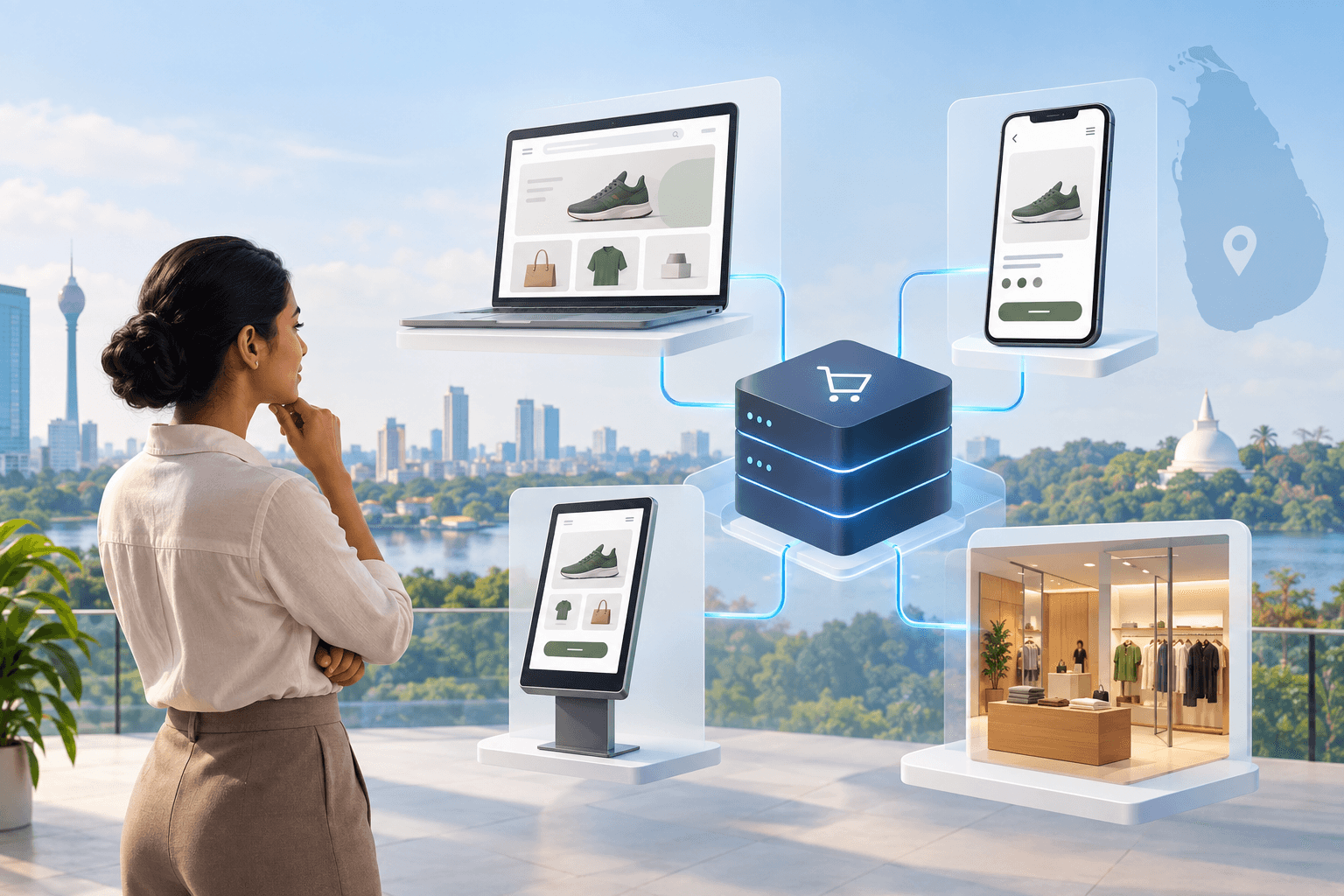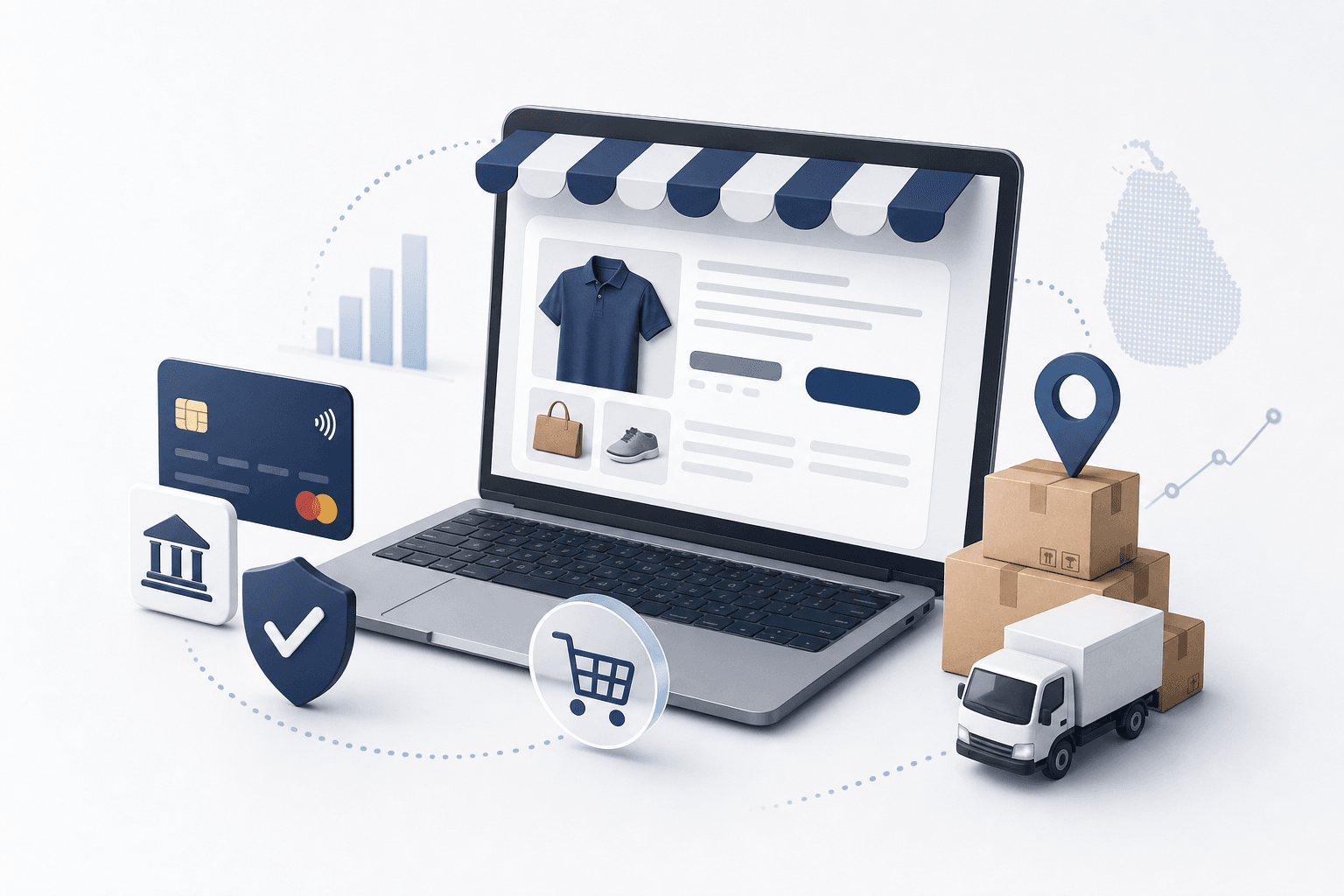
Planning an ecommerce website in Sri Lanka? Use this practical guide to define platforms, payments, delivery, integrations, costs and launch priorities.
Key takeaways
- Start ecommerce planning with your business model and operating workflow, not the homepage design or platform brand.
- Choose Shopify, WooCommerce or custom development based on operational fit, maintenance ownership and long-term cost.
- Document local requirements for payments, delivery, inventory, POS and ERP integration before requesting proposals.
- Compare ecommerce website costs in Sri Lanka using the same scope, including recurring subscriptions, integrations and post-launch support.
- A clear vendor brief produces more comparable proposals and reduces project risk.
An ecommerce website is not simply a catalogue with a checkout button. It is a working part of your retail operation. It must show accurate products and stock, accept the payment methods your customers trust, pass orders into a reliable fulfilment process, and give your team the information needed to serve customers after the sale.
That is why planning an ecommerce website in Sri Lanka should begin with the operating model, not the homepage design. A polished storefront can still fail if inventory is wrong, delivery charges appear too late, payment confirmations require manual checking, or staff cannot update products without technical help.
This guide explains the decisions a Sri Lankan retailer should make before requesting proposals or choosing a platform. It is designed for businesses launching their first online store as well as established retailers replacing a disconnected or underperforming ecommerce setup.
Start With the Business Model, Not the Platform
Shopify, WooCommerce and custom development are implementation options. None of them can compensate for an unclear commercial model.
Before comparing platforms, define what customers will buy, where orders can be delivered, how stock will be reserved, who owns fulfilment, and what happens when an order is changed or returned.
Define the customer and sales model
Clarify whether the store will serve:
- Consumers, business buyers, or both
- Sri Lankan customers, international customers, or selected regions
- Retail buyers at standard prices or account customers with negotiated terms
- One brand, multiple brands, a marketplace, or a wholesale catalogue
- Online-only customers or customers who also shop in physical outlets
These choices affect pricing rules, tax handling, product visibility, payment methods, delivery logic, account features and integrations.
Map the order journey
Write down the full journey from product discovery to post-purchase support:
- A customer finds a product.
- The site confirms availability, price and delivery terms.
- The customer chooses a payment and delivery method.
- The business receives and validates the order.
- Stock is reserved or reduced in the correct system.
- The order is picked, packed and dispatched.
- The customer receives updates.
- Returns, exchanges, refunds and support are handled.
Any step that depends on copying data between systems is a risk worth discussing during discovery.
Choose an Ecommerce Platform Based on Operational Fit
The best platform is the one that meets the required workflows with an acceptable level of customisation, maintenance and long-term cost.
When Shopify may be the right fit
Shopify is often suitable when a business wants a managed ecommerce platform, a relatively fast route to market, predictable core hosting and security responsibilities, and access to an established app ecosystem.
It can be a strong choice for retail and direct-to-consumer brands, especially when the store can operate within standard commerce patterns. The important question is not whether an app exists, but whether the combined theme, app and integration setup will remain manageable as the store grows.
Review the complete requirement list before assuming every workflow should be solved with another app. App subscriptions, data ownership, checkout limitations and integration dependencies should be included in the decision. For a closer platform comparison, see our Shopify vs WooCommerce guide for Sri Lankan businesses.
When WooCommerce may be the right fit
WooCommerce can suit businesses that already use WordPress, need content and commerce to work closely together, or require deeper control over the storefront and supporting code.
That flexibility also creates responsibility. Hosting, updates, backups, plugin compatibility, security monitoring and performance optimisation require clear ownership. A proposal should explain who manages these duties after launch.
When custom development may be justified
A custom ecommerce solution may be appropriate when the business has processes that cannot be handled cleanly by a standard platform. Examples may include unusual B2B pricing, multi-party workflows, complex approval rules, specialised integrations or a broader digital product in which commerce is only one component.
Custom development should solve a proven operational requirement. It should not be chosen only because it sounds more flexible. The business must also budget for ongoing maintenance, security, infrastructure and future development.
Build the Requirements Around Real Sri Lankan Commerce Workflows
A useful ecommerce requirements document covers more than page designs. It describes how the store will work with payments, inventory, delivery, customer service and reporting.
Product catalogue and merchandising
Document the expected number of products, categories and variants. Note whether the team needs size guides, product bundles, related items, subscriptions, downloadable products, pre-orders or product comparison.
Product data quality matters just as much as technology. Agree on who will prepare titles, descriptions, specifications, prices, images, search filters, weights and dimensions. Define a repeatable approval process before bulk product entry begins.
Payments and payment confirmation
List the payment methods required at launch and confirm their current technical and commercial requirements directly with each provider. Consider cards, bank transfers, cash on delivery, instalment options and any relevant digital payment methods.
The technical workflow should address:
- Successful, failed and abandoned payments
- Duplicate callbacks or delayed confirmation
- Refund and partial-refund handling
- Reconciliation between the website, gateway and finance records
- Customer notifications when payment status changes
- Access control for staff handling payment information
Do not treat the payment gateway logo on the checkout page as the entire integration. The back-office confirmation and reconciliation process is equally important.
Inventory, POS and ERP integration
For a retailer with physical outlets or an existing ERP, inventory integration is often the most important scope item.
Define which system is the source of truth for stock, prices, product codes and customer records. Then specify how quickly updates must move between systems and what should happen when a system is unavailable.
Questions to resolve include:
- Is stock shared across branches, warehouses and the online store?
- When is stock reserved: at cart, order or confirmed payment?
- How are cancellations and returns added back?
- Can the store prevent overselling during promotions?
- Are online and in-store prices always the same?
- Who investigates failed synchronisation?
Konekt's retail digital transformation service describes ecommerce, POS, ERP, inventory, loyalty and delivery as connected parts of the retail stack. That connected view is valuable when an online store must work alongside existing operations.
Delivery, pickup and returns
Delivery rules should be decided before checkout design. Specify delivery zones, charges, free-delivery thresholds, pickup options, restricted products and expected dispatch times.
If a courier or internal delivery operation must be integrated, define what data is sent, how labels or jobs are created, how tracking updates reach the customer, and how failed deliveries are handled.
Returns and exchanges also need a workflow. Customers should understand eligibility, time limits and the steps they must follow. Staff need a consistent way to update order, payment and stock records.
Mobile experience and site performance
Many customers will discover, compare and buy products on a phone. Test the complete journey on real devices and typical network conditions, not only on a desktop browser.
Prioritise:
- Clear category navigation and search
- Readable product information and images
- Simple variant selection
- Transparent delivery information
- A short, understandable checkout
- Helpful validation and error messages
- Fast loading without unnecessary scripts
- Accessible controls, contrast and form labels
Performance should be treated as an ongoing operating metric because apps, tracking scripts, new media and catalogue growth can slow a store after launch.
Understand What Drives Ecommerce Website Cost in Sri Lanka
There is no reliable single price for every ecommerce website in Sri Lanka. A meaningful estimate depends on the scope and the responsibilities included.
The main cost drivers are:
- Platform subscription, hosting and infrastructure
- Theme or custom user-experience design
- Product count, variants and catalogue migration
- Payment and delivery integrations
- POS, ERP, CRM or accounting integrations
- Custom pricing, loyalty or promotion logic
- Content production and product photography
- Search, filtering and merchandising requirements
- Analytics, consent and marketing integrations
- Security, testing, training and documentation
- Maintenance, monitoring and support after launch
When comparing proposals, ask each supplier to separate one-time implementation costs from recurring platform, app, hosting, support and transaction-related costs. Also ask which third-party fees are estimates and which are paid directly by the business.
A low initial quote can become expensive if product migration, testing, integrations, support or performance work is excluded. A higher quote is not automatically better either. The comparison should be based on the same documented scope.
Prepare a Vendor Brief That Produces Comparable Proposals
A short but specific brief reduces assumptions and makes vendor evaluation more objective.
Include:
- Business goals and target customers
- Product scope, catalogue complexity and pricing model
- Required payment, delivery and fulfilment workflows
- Current systems that must integrate with the store
- Roles and responsibilities after launch
- Budget range, timeline and internal stakeholders
- Content, product data and asset readiness
- Success metrics for launch and the first 90 days
If you are comparing suppliers, this vendor evaluation guide can help structure requirements, compare proposals and assess long-term support capability.
Questions to Ask Before You Request a Proposal
- What business problem should the online store solve first?
- Which systems already contain product, stock and customer data?
- What operational steps are still manual today?
- Which launch features are essential, and which can wait for phase two?
- Who owns catalogue maintenance, order handling and customer support?
- How will success be measured after launch?
Conclusion
An ecommerce website in Sri Lanka should be planned as an operating system for digital retail, not only as a design project. The strongest results usually come from clear workflows, realistic scope, well-defined ownership and the right platform fit for the business model.
Before committing to a build, make sure your requirements reflect how products, payments, delivery, inventory and customer service actually work. That preparation will improve proposal quality, reduce launch risk and create a stronger foundation for growth.
Frequently asked questions
What is the first step in planning an ecommerce website in Sri Lanka?
Start by defining the business model, target customers, fulfilment process, stock ownership and post-order workflow before comparing platforms or design options.
Is Shopify or WooCommerce better for Sri Lankan ecommerce businesses?
Neither is always better. Shopify often suits businesses that want faster launch and lower maintenance, while WooCommerce can suit businesses that need WordPress integration or deeper code-level control.
What affects ecommerce website cost in Sri Lanka?
Cost depends on scope, platform, catalogue size, payment and delivery integrations, POS or ERP integration, design requirements, content production, testing, support and recurring subscriptions.
Why is inventory integration important for an online store?
Inventory integration helps keep stock accurate across the online store and physical operations, reduces overselling risk and supports a smoother fulfilment process.
What should be included in an ecommerce vendor brief?
Include business goals, target customers, catalogue scope, required workflows, integrations, ownership after launch, budget range, timeline and success metrics.

Dilan Pushpitha
Dilan Pushpitha brings strategic business leadership and digital commerce expertise to Konekt, driving operational excellence, client success, and growth-focused technology solutions. With a strong background in e-commerce, UI/UX, automation, and digital strategy, he helps bridge business needs with practical, scalable digital implementation.