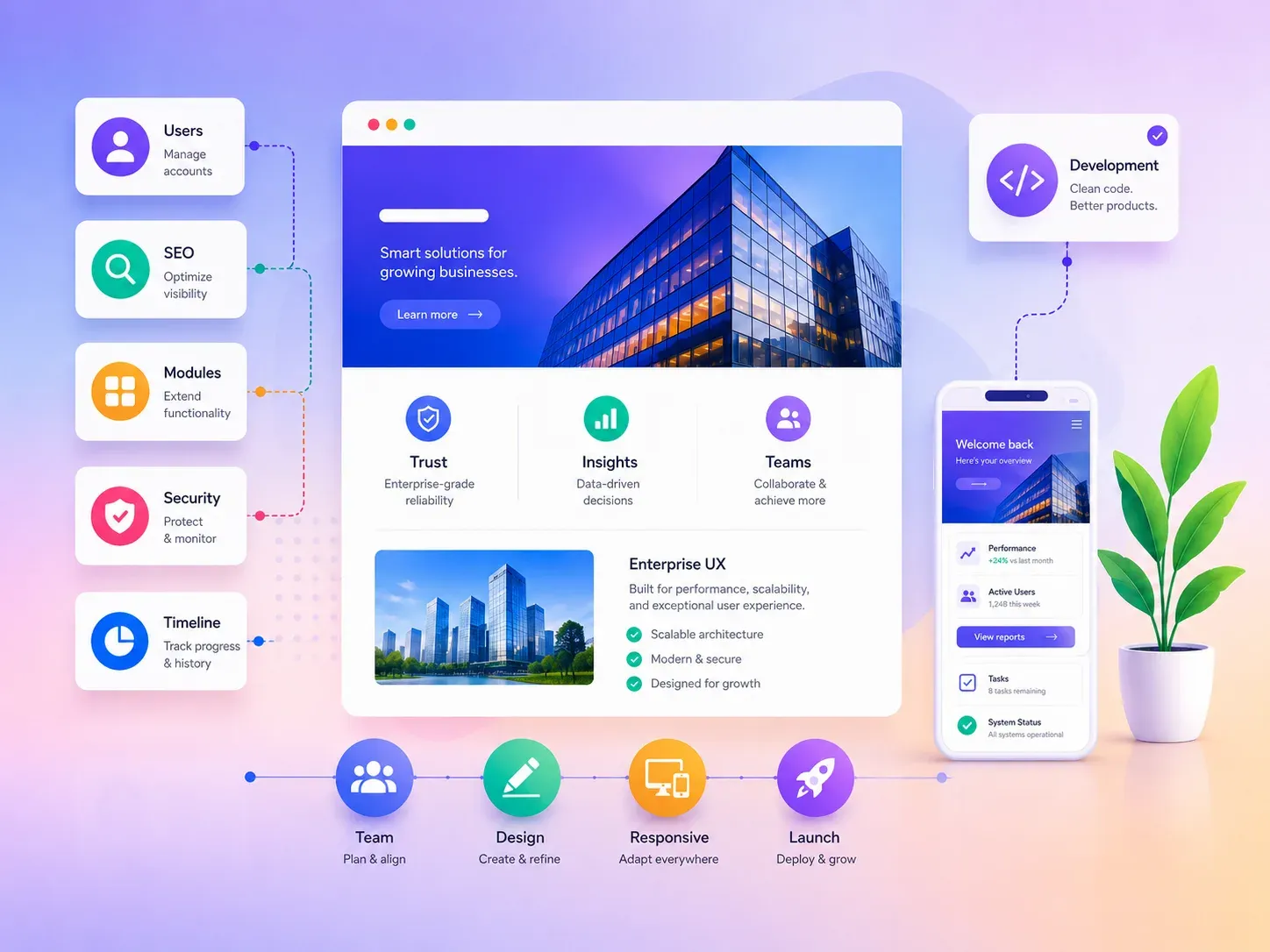
Planning a corporate website redesign? Here's what enterprise teams should prioritize — strategy, design systems, SEO, performance, accessibility, security, integrations, and the right team.
Key takeaways
- Enterprise websites need a strategy phase first — clear goals, audience, and information architecture before any visual design begins.
- A documented design system keeps brand and UI consistent as the site grows from a handful of pages to dozens of services, industries, and blog posts.
- SEO-first architecture and Core Web Vitals performance directly affect lead generation — they shouldn't be retrofitted after launch.
- Accessibility (WCAG 2.1 AA) is increasingly a baseline requirement for enterprise procurement, not just a usability nice-to-have.
- The right partner brings a dedicated team, a formal QA stage, and experience with the integrations — CRM, analytics, automation — your business already relies on.
For an enterprise, the corporate website isn't a brochure — it's the first impression for prospects, investors, partners, and even future employees. It has to carry the weight of the brand, support a sales pipeline, rank for competitive search terms, and stay maintainable as the organisation grows. That's a different brief from a small business site, and it changes what "good design" actually means.
If you're an enterprise evaluating a website redesign or a new build, here's what to look for — and what to ask any agency you're considering.
1. Strategy Before Visual Design
A polished homepage mockup means little if it isn't grounded in your business goals, target audience, and competitive landscape. Before any design work starts, your partner should be able to answer: who is this site for, what do we want them to do, and how does that map to your sales and marketing funnel?
Look for a discovery phase that produces a clear sitemap and information architecture — not just a Figma file. This is also where SEO strategy should begin, not get bolted on afterwards.
2. A Scalable Design System and Brand Consistency
Enterprise sites rarely stay at 8 pages. Service pages, industry pages, case studies, careers, investor relations, and a growing blog all get added over time. Without a proper design system — consistent components, typography, spacing, and colour usage — that growth produces a site that looks stitched together from different eras.
- Reusable components (headers, cards, CTAs, forms) that stay consistent as new pages are added
- A documented brand system so future pages match without re-briefing a designer each time
- Design files (e.g. Figma) handed over so your team retains ownership, not just the live site
3. SEO-First Information Architecture
For enterprises competing for high-intent search terms, SEO can't be an afterthought. The site structure itself — how services, industries, and content are organised and internally linked — has a direct impact on how well it ranks.
Things to check for:
- A logical URL structure and internal linking strategy between services, case studies, and blog content
- Technical SEO basics handled by default: meta titles and descriptions, structured data, sitemaps, canonical URLs
- A content plan that targets keywords your buyers are actually searching for, not just generic descriptions of your services
4. Performance and Core Web Vitals
More than half of visitors abandon a page that takes longer than three seconds to load — and Google's Core Web Vitals are a ranking factor. For enterprise sites with rich media, multiple integrations, and large content libraries, performance has to be designed in, not patched in afterwards.
Ask how the build will handle image optimisation, caching, and code splitting, and request real performance numbers (Lighthouse or PageSpeed scores) from the agency's previous enterprise projects.
5. Mobile-First, Responsive Across Devices
A growing share of enterprise traffic — including from decision-makers — happens on mobile. The site needs to work flawlessly across phones, tablets, and desktops, not just "shrink" on smaller screens. Navigation, forms, and CTAs should be designed mobile-first and tested on real devices, not just a browser resize.
6. Accessibility and Compliance
Accessibility is no longer a nice-to-have. It affects usability, SEO, and increasingly, legal and procurement requirements — many enterprise RFPs now ask for WCAG 2.1 AA compliance directly. A properly built corporate site should have:
- Sufficient colour contrast and readable typography
- Keyboard-navigable menus, forms, and interactive elements
- Proper heading structure and alt text for images, so screen readers and search engines can both understand the page
7. A CMS Your Team Can Actually Use
Enterprise marketing teams need to publish blog posts, update case studies, and refresh service pages without filing a developer ticket every time. The CMS should give your team real editorial control — structured content fields, an easy-to-use editor, and the ability to update SEO metadata per page — while developers retain control over design and components.
8. Security, Hosting, and Scalability
An enterprise website is a target, and it needs to behave like production infrastructure: HTTPS by default, regular updates and patching, secure form handling, and backups. It also needs to scale — both in terms of traffic (product launches, PR coverage, ad campaigns) and in terms of content (hundreds of pages without performance degrading).
9. Integrations With Your Existing Stack
Your website rarely operates in isolation. It needs to connect cleanly to the tools your sales and marketing teams already rely on:
- CRM integration for lead capture and routing
- Analytics and tag management (GA4, Google Tag Manager, conversion tracking)
- Live chat, scheduling tools, or marketing automation platforms
- Multi-language support, if you operate across regions
Each of these should be scoped and tested as part of the build — not treated as an afterthought once the site is "done."
10. A Team and Process You Can Rely On
Finally, look past the portfolio and evaluate the team and process behind it. Enterprise projects involve multiple stakeholders, longer timelines, and more moving parts — so you want a partner with:
- A dedicated project manager and a consistent point of contact throughout
- Business analysis upfront to translate your requirements into a clear, scoped plan
- QA as a formal stage, not an informal final check
- Experience across your industry's specific compliance, accessibility, and audience expectations
How Konekt Approaches Corporate Website Design
At Konekt, every corporate website design project starts with strategy and high-fidelity Figma designs before a single line of code is written. You work with a dedicated project manager, an in-house designer, and a senior developer — with no outsourcing or third-party handoffs — across discovery, design, development, QA, and launch.
We've designed and built corporate websites for enterprises across banking, microfinance, retail, education, manufacturing, and professional services, including a full brand transformation for STI Holdings as part of their global rebrand. If you're planning a redesign, our broader web development services page covers the full range of platforms and capabilities we support.
Already have a site and unsure where it falls short? Our website revamp checklist for 2026 is a good place to start.
Frequently asked questions
What's the difference between a corporate website and a regular business website?
A corporate website typically serves more audiences — investors, partners, job candidates, press — and more pages, including services, industries, case studies, and careers. That requires a stronger information architecture, design system, and content governance than a small brochure site.
How long does a corporate website redesign typically take?
For a properly scoped enterprise site with discovery, custom design, multiple page templates, and integrations, 8–12 weeks is typical — though scope, page count, and stakeholder review cycles can extend this.
Do we need a headless CMS for an enterprise website?
Not always. What matters more is whether the CMS gives your marketing team real editorial control — structured fields, easy publishing, and per-page SEO settings — while developers retain control over design and components. A headless CMS can help with this, but a well-configured traditional CMS can too.
How important is accessibility for a corporate website?
Increasingly important. Beyond usability and SEO benefits, many enterprise RFPs and procurement processes now require WCAG 2.1 AA compliance, and it reduces legal risk in markets with accessibility regulations.
Can our redesign be done without losing existing SEO rankings?
Yes, if it's planned for. URL structures, redirects, metadata, and content need to be mapped from the old site to the new one before launch, and rankings should be monitored closely in the weeks after.

Dilan Pushpitha
Dilan Pushpitha brings strategic business leadership and digital commerce expertise to Konekt, driving operational excellence, client success, and growth-focused technology solutions. With a strong background in e-commerce, UI/UX, automation, and digital strategy, he helps bridge business needs with practical, scalable digital implementation.