
Key takeaways
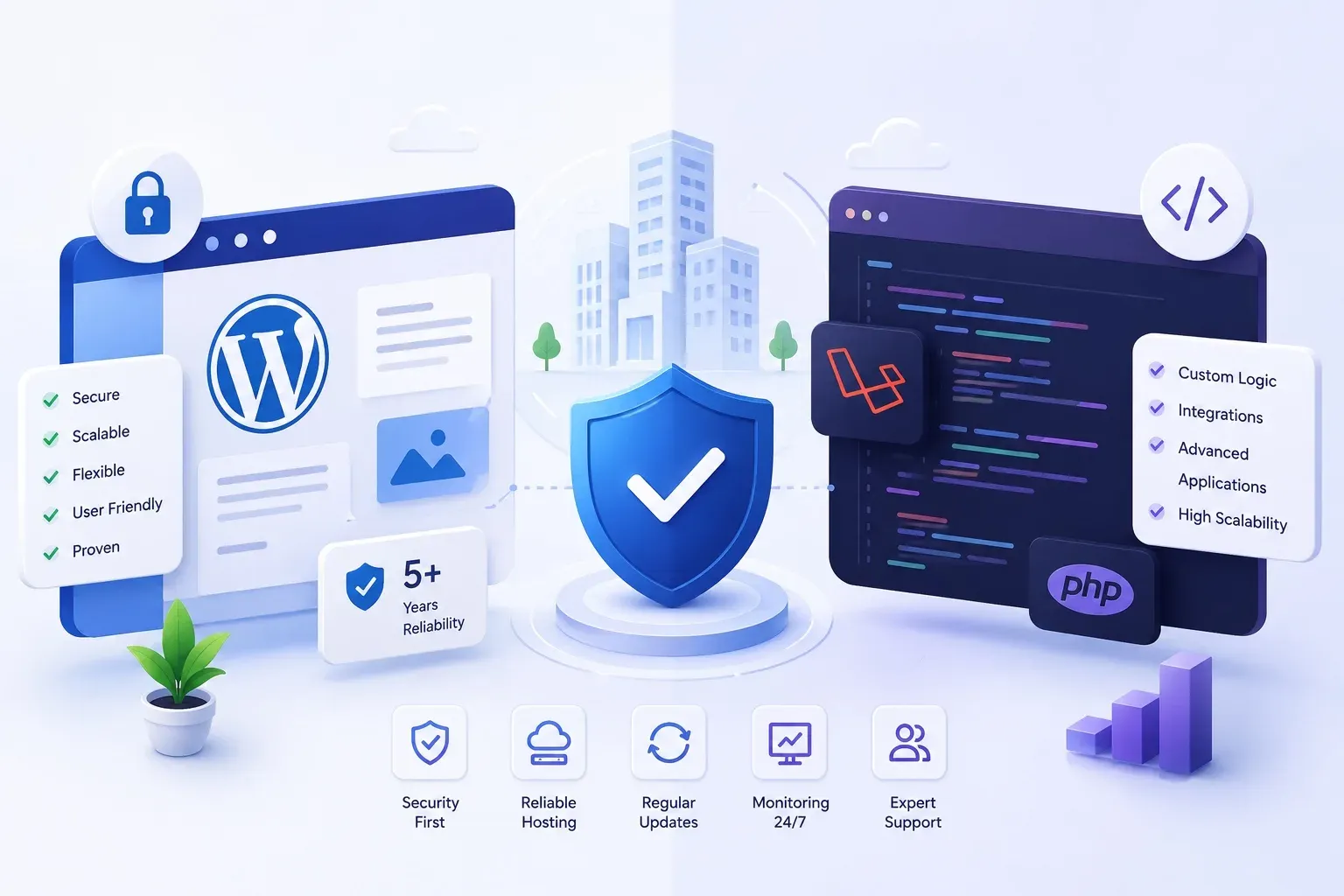
- 01WordPress security depends more on implementation, maintenance, hosting, and access controls than on the platform name itself.
- 02Enterprise WordPress can support established organizations when it is professionally architected, monitored, updated, and backed up.
- 03Laravel is better suited to portals, SaaS products, complex workflows, transactions, and custom business logic.
- 04The correct platform decision should consider content ownership, integrations, risk, operational capability, and total cost of ownership.
The Problem Is Usually Not WordPress
Many organizations associate WordPress with security issues because of previous experiences with poorly maintained websites. In practice, the platform itself is rarely the only cause. Most incidents can be traced to outdated plugins and themes, weak passwords, unsuitable hosting, excessive administrator access, missing backups, poor configuration, or a lack of ongoing monitoring and updates.
A professionally managed WordPress website should be treated as a maintained business system rather than a one-time design project. This means applying security patches promptly, limiting the number of plugins, reviewing third-party code, enforcing strong authentication, protecting forms and login pages, monitoring suspicious activity, and maintaining tested backups. When these controls are in place, WordPress can provide a secure and dependable foundation for a corporate website.
Why Large Organizations Still Choose WordPress
WordPress powers a substantial part of the web and continues to be selected by large organizations because it combines a mature ecosystem with practical content management, extensibility, scalability, and cost efficiency. It gives businesses access to proven publishing workflows, media management, multilingual capabilities, search optimization tools, integrations, and a large global pool of experienced developers.
For many corporate website projects, the primary requirement is not complex application logic. It is the ability to present services, publish news and insights, manage campaign pages, maintain leadership and investor information, support multiple content owners, and integrate with marketing or customer engagement tools. WordPress addresses these requirements without forcing the organization to build a custom content management system from the ground up.
Corporate Websites Need Manageability
Marketing, communications, human resources, and corporate affairs teams need the ability to manage content independently. WordPress enables authorized users to publish and update pages, news articles, media, announcements, landing pages, and search metadata without requiring developer involvement for every routine change.
This manageability has a direct operational benefit. Content can be updated faster, campaign launches are less dependent on engineering schedules, and the organization avoids turning simple website edits into software development tasks. With clearly defined roles, approval workflows, reusable page components, staging environments, and governance guidelines, WordPress can support both editorial flexibility and organizational control.
Enterprise WordPress Websites Built by Konekt
Konekt has successfully delivered and maintained WordPress websites for organizations across multiple industries, including:
- Softlogic Life Insurance
- Hayleys Life Sciences
- Gateway College
- Imperial College of Business Studies (ICBS)
These projects demonstrate that WordPress can support established brands, education providers, financial services organizations, and diversified corporate groups when the solution is designed and maintained correctly.
Many of these websites have operated reliably for years with structured maintenance, security monitoring, controlled updates, performance optimization, backups, and technical support. Long-term reliability comes from the operating model around the website: responsible ownership, documented access, proactive maintenance, suitable infrastructure, and a team that understands both the platform and the organization’s business requirements.
Can WordPress Power Enterprise Websites?
The answer is yes. Organizations often assume that an enterprise website must be built using Laravel or a custom CMS to be secure, scalable, and professional. However, many enterprise organizations choose WordPress because it provides a strong balance between security, content management flexibility, scalability, implementation speed, and cost efficiency.
An enterprise WordPress implementation can include cloud hosting, content delivery networks, web application firewalls, caching, image optimization, staging and deployment workflows, role-based access, single sign-on, monitoring, automated backups, and integrations with CRM, analytics, recruitment, payment, or marketing platforms. The architecture should be designed around expected traffic, content complexity, compliance needs, integrations, and internal publishing processes.
Enterprise capability is therefore not determined by whether the administrator panel says WordPress or Laravel. It is determined by how the solution is architected, developed, secured, tested, deployed, monitored, and supported.
Security Depends on Implementation
Secure hosting, regular updates, controlled plugin usage, monitoring, backups, access management, and application hardening determine the security of a website more than the platform name alone. A poorly maintained Laravel application can also become vulnerable through outdated dependencies, insecure custom code, weak authentication, exposed infrastructure, or missing operational controls.
For WordPress, a responsible security approach includes selecting reputable plugins, removing unused themes and extensions, protecting administrative access, applying updates through a controlled process, scanning for malicious changes, restricting file permissions, securing the database and server, using HTTPS, and maintaining recoverable backups. For Laravel, security depends heavily on development quality, code review, dependency management, secure configuration, authorization design, server management, and continued application maintenance.
Neither platform removes the need for professional security practices. The real comparison is between a well-managed implementation and an unmanaged one.
When Laravel Makes More Sense
Laravel is the better choice for portals, SaaS products, loan management systems, learning management platforms, ERP integrations, workflow-driven systems, and applications that require custom business logic. It gives development teams greater control over data models, permissions, processes, APIs, integrations, and application behavior.
A company should consider Laravel when the project goes beyond publishing and content management. Examples include customer or partner logins, multi-step approvals, transaction processing, complex calculations, tenant-specific data, operational dashboards, internal workflows, advanced reporting, or deep integration with core business systems.
Laravel may also be appropriate when the organization requires a completely custom user experience or application architecture. However, this flexibility comes with greater development effort, a higher long-term dependency on software engineers, and the responsibility to build and maintain features that WordPress already provides for content teams.
The Right Question to Ask
Instead of asking only whether WordPress is secure, organizations should evaluate who is designing, building, hosting, and maintaining the website. They should also ask whether the proposed platform matches the actual business requirement.
Important questions include: Who will manage content after launch? How frequently will the website change? What integrations are required? Does the project contain custom workflows or mainly public-facing content? What security and backup processes will be implemented? Who will apply updates, monitor availability, and respond to incidents? What is the total cost of ownership over several years?
A platform decision based only on reputation or personal preference can lead to unnecessary cost and complexity. The best decision is based on business functionality, editorial needs, risk, operational capability, integration requirements, and long-term support.
Final Thoughts
Both WordPress and Laravel have an important place in modern web development. WordPress is often the stronger choice for corporate websites that require efficient content management, marketing flexibility, rapid publishing, search visibility, and predictable operating costs. Laravel is generally the stronger choice for custom applications that depend on unique workflows, business rules, user portals, transactions, and system integrations.
The right choice depends on business requirements, content management needs, integrations, scalability goals, security expectations, internal resources, and long-term operational plans. A well-implemented WordPress website can be secure, scalable, and enterprise-ready, while a well-engineered Laravel application can provide the flexibility required for complex digital products.
Rather than selecting a platform first and forcing the project to fit it, organizations should begin with the problem they need to solve and choose the technology that supports that outcome with the least unnecessary complexity.
- WordPress
- Laravel
- Corporate Websites
- Website Security
- Enterprise Web Development