
Key takeaways
- 01Evaluate website vendors based on technical capability, security, UX, delivery process, support, and commercial value.
- 02Do not select a website development company based only on the lowest price.
- 03Sri Lankan organizations should prioritize vendors with relevant industry experience and long-term support capability.
- 04A structured scorecard helps compare proposals objectively and reduce project risk.
Selecting a website development company is a critical business decision. Whether you are planning a corporate website, e-commerce platform, educational portal, customer self-service portal, or digital transformation initiative, the right technology partner can significantly influence project success.
Many organizations focus primarily on pricing when comparing vendors. However, website development is a long-term investment. Factors such as technical expertise, user experience, security, support quality, and scalability often have a greater impact on business outcomes than the initial project cost.
This guide provides a structured framework that organizations in Sri Lanka can use to evaluate website development vendors objectively and make informed decisions.
Why Choosing the Right Website Development Company Matters
A modern website serves as much more than an online brochure. It is often the first point of interaction between an organization and its customers.
An effective website can:
- Strengthen brand credibility
- Generate qualified leads
- Increase online sales
- Improve customer engagement
- Streamline business processes
- Support digital marketing initiatives
Conversely, selecting the wrong vendor can result in project delays, poor user experience, security vulnerabilities, costly redesigns, and ongoing maintenance challenges.
Understanding the Website Development Market in Sri Lanka
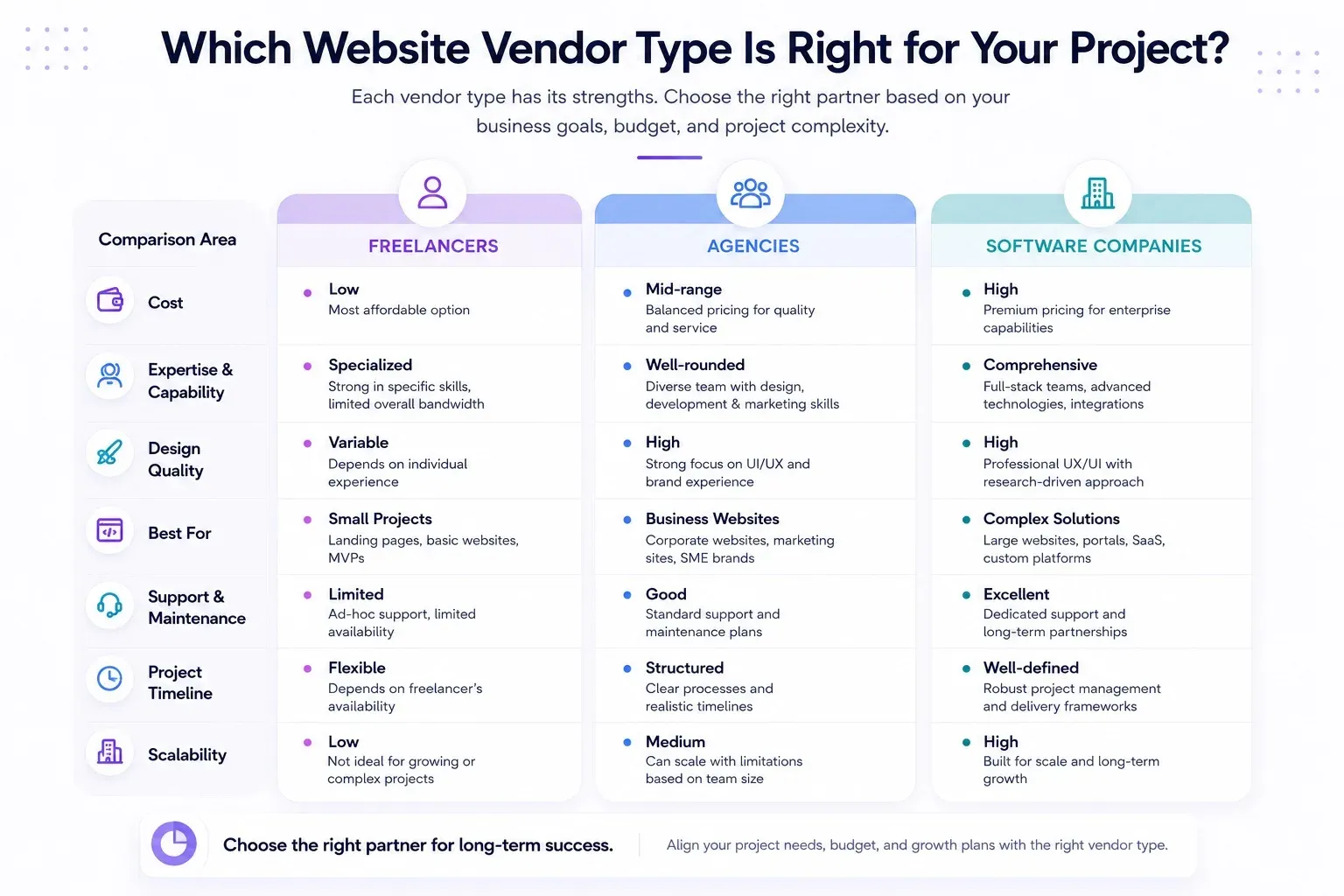
Organizations typically encounter several categories of vendors when evaluating proposals.
Freelancers
Freelancers are often suitable for simple websites and startup projects where budget is the primary consideration. They can be cost-effective for basic projects, but may have limitations in scalability, structured project management, and long-term support.
Web Design Agencies
Web design agencies generally focus on branding, visual design, and user experience. They are well-suited for marketing websites, corporate websites, and brand-focused digital experiences.
Digital Marketing Agencies
Digital marketing agencies often combine website development with SEO, content marketing, analytics, and advertising services. They can be a good fit when the website is closely connected to lead generation and campaign performance.
Software Development Companies
Software development companies typically provide broader technical capability, including custom development, integrations, portals, e-commerce systems, and enterprise applications. They are often better suited for organizations that require scalability, security, system integrations, and long-term technology support.
Website Vendor Evaluation Framework
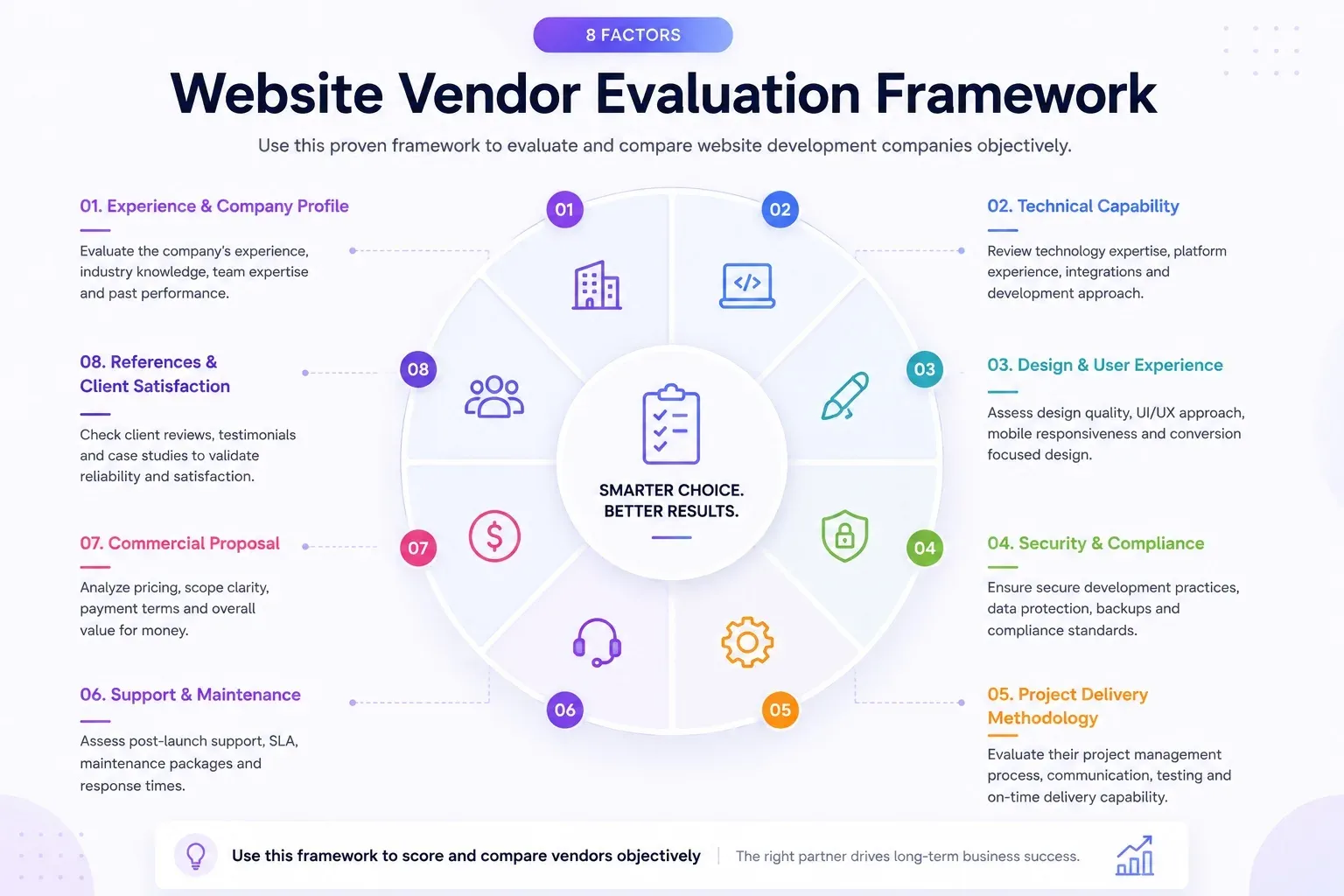
The following weighted framework can be used to compare vendors objectively.
| Evaluation Area | Weight |
|---|---|
| Company Profile & Experience | 15% |
| Technical Capability | 20% |
| Design & User Experience | 10% |
| Project Delivery Methodology | 10% |
| Security & Compliance | 10% |
| Support & Maintenance | 10% |
| Commercial Proposal | 15% |
| References & Client Satisfaction | 10% |
| Total | 100% |
1. Company Profile and Industry Experience
Experience is often one of the strongest indicators of successful project delivery. A vendor that understands your industry can reduce project risk, provide better recommendations, and anticipate common challenges.
Evaluate:
- Years in operation
- Industry-specific experience
- Team size and expertise
- Local support availability
- Client portfolio
- Ability to provide references
Organizations should seek vendors with proven experience in their sector. For example, retailers should prioritize vendors with e-commerce, inventory, payment gateway, and loyalty integration experience. Educational institutions should look for experience with learning management systems, student portals, payment workflows, and digital attendance. Financial institutions should prioritize secure development, customer portals, compliance awareness, and data protection practices.
2. Technical Capability
Technical capability determines whether the vendor can deliver a scalable, secure, and maintainable solution.
Platform Expertise
Assess whether the vendor has practical experience with the technologies relevant to your project, such as:
- WordPress
- Shopify
- WooCommerce
- Laravel
- React
- Next.js
- Headless CMS platforms
A basic corporate website may be suitable for WordPress, while an e-commerce business may require Shopify, WooCommerce, or a custom commerce platform. A portal, internal system, or complex workflow may require Laravel, React, or a custom application architecture.
Integration Experience
Many modern websites are connected to business systems. Evaluate whether the vendor can integrate with:
- ERP systems
- CRM platforms
- Payment gateways
- Learning Management Systems
- Inventory management systems
- Accounting systems
- Mobile applications
- Third-party APIs
Ask vendors to demonstrate previous integration projects. This is especially important for retail, education, finance, and enterprise organizations.
Performance Optimization
A high-performing website should provide a fast, reliable experience across devices. Evaluate whether the vendor understands page speed optimization, mobile performance, CDN implementation, caching strategies, image optimization, and Core Web Vitals.
3. User Experience and Design Quality
A visually attractive website must also be easy to use. Good design should support business objectives, not only brand presentation.
Design Quality
Review previous projects to assess visual appeal, brand consistency, modern design practices, quality of layouts and typography, and suitability for the target audience.
User Experience
Assess whether the vendor considers navigation structure, information architecture, user journeys, clear calls to action, mobile responsiveness, and conversion-focused design.
A website should make it easy for visitors to understand your value, find relevant information, and take the next step.
Accessibility
Accessibility is becoming increasingly important for modern websites. Vendors should consider readable typography, sufficient color contrast, keyboard navigation, and screen reader-friendly structure.
4. Security and Compliance
Website security should be a mandatory evaluation criterion, particularly for banks, finance companies, insurance companies, educational institutions, healthcare organizations, and e-commerce businesses.
Secure Development Practices
Confirm whether the vendor follows secure coding standards and understands common web application vulnerabilities.
SSL and Encryption
All websites should use HTTPS encryption. Sensitive forms, payment workflows, login areas, and customer portals require additional attention.
Backup and Disaster Recovery
Understand backup frequency, recovery procedures, data retention policies, hosting-level protection, and responsibility during incidents.
Vulnerability Management
Ask vendors how they identify and address security vulnerabilities after launch. A strong vendor should have a clear process for patching, updating, and monitoring systems.
5. Project Delivery Methodology
A structured delivery process reduces project risk and improves communication between the client and vendor.
Look for vendors that provide discovery workshops, requirement documentation, sitemaps, wireframes, user flows, technical architecture, project timelines, and a testing plan.
Discovery Workshops
The project should begin with requirement gathering sessions involving key stakeholders. This helps clarify business objectives, target audiences, features, content needs, integrations, and success metrics.
Documentation
Expected deliverables may include functional specifications, sitemap, wireframes, user flows, technical architecture, project timeline, and testing plan.
Project Management
Preferred project management tools include Jira, ClickUp, Azure DevOps, Trello, and Asana. The specific tool matters less than the vendor's ability to communicate clearly, track progress, manage risks, and provide visibility.
Testing
Testing should cover functional testing, browser compatibility, mobile responsiveness, user acceptance testing, performance testing, and security review. A proper UAT process ensures the website is reviewed and approved before launch.
6. Support and Maintenance
Website development is only the beginning of the lifecycle. Long-term success depends on continuous maintenance, security updates, performance monitoring, and enhancements.
Service Level Agreements
Understand response times, resolution targets, escalation procedures, support channels, and availability for urgent issues.
Ongoing Maintenance
Support packages should cover security updates, bug fixes, platform upgrades, plugin or dependency updates, performance monitoring, backup checks, and minor content or configuration support.
For business-critical websites, ongoing maintenance should be included in the evaluation from the beginning.
7. Commercial Proposal Evaluation
The lowest-cost proposal does not necessarily represent the best value. A low initial cost can lead to higher long-term expenses if the project lacks quality, scalability, documentation, or support.
Scope Clarity
The proposal should clearly define deliverables, assumptions, exclusions, timeline, payment milestones, revision limits, and support terms.
Total Cost of Ownership
Consider development cost, hosting cost, licensing fees, maintenance cost, future enhancement cost, and third-party service fees.
Payment Terms
Review milestone structures carefully. A common structure may include an advance payment, progress-based milestone payments, and a final payment upon completion or launch.
8. Client References and Reputation
Reference checks provide valuable insights into actual project performance. A vendor's portfolio shows what they delivered, but references can reveal how they delivered it.
Questions to ask previous clients include:
- Was the project delivered on time?
- Did the vendor stay within budget?
- How responsive was the support team?
- Were issues handled professionally?
- Would you work with them again?
Also review Google Reviews, LinkedIn recommendations, case studies, client testimonials, and repeat business from existing clients.
Common Mistakes Organizations Make When Selecting a Website Vendor
Selecting Based Only on Price
Price is important, but it should not be the only factor. Lower-cost vendors may lack the experience required for complex projects.
Ignoring Security
Security weaknesses can expose organizations to financial, operational, and reputational risks.
Overlooking Maintenance Requirements
Websites require continuous updates, monitoring, and improvements. A vendor without a proper support process can create long-term operational challenges.
Focusing Only on Visual Design
A good-looking website can still fail if it lacks performance, SEO structure, integrations, conversion strategy, and maintainability.
Failing to Verify References
Past performance is often one of the best predictors of future success.
Website Vendor Evaluation Scorecard
Organizations can use a simple scoring matrix to compare vendors objectively.
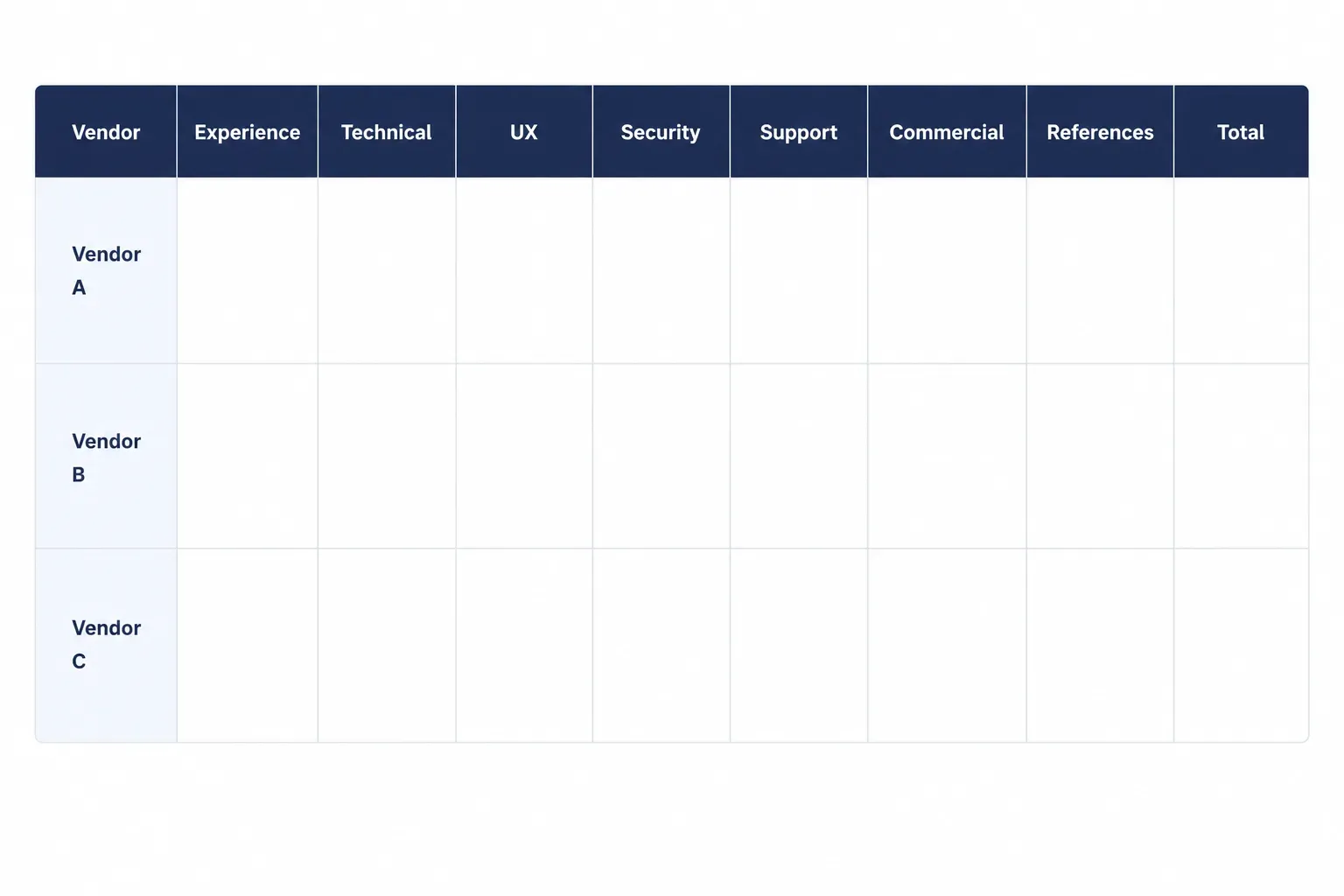
A structured scorecard helps decision-makers compare proposals based on value, capability, and risk rather than subjective preference alone.
Website Vendor Selection Process
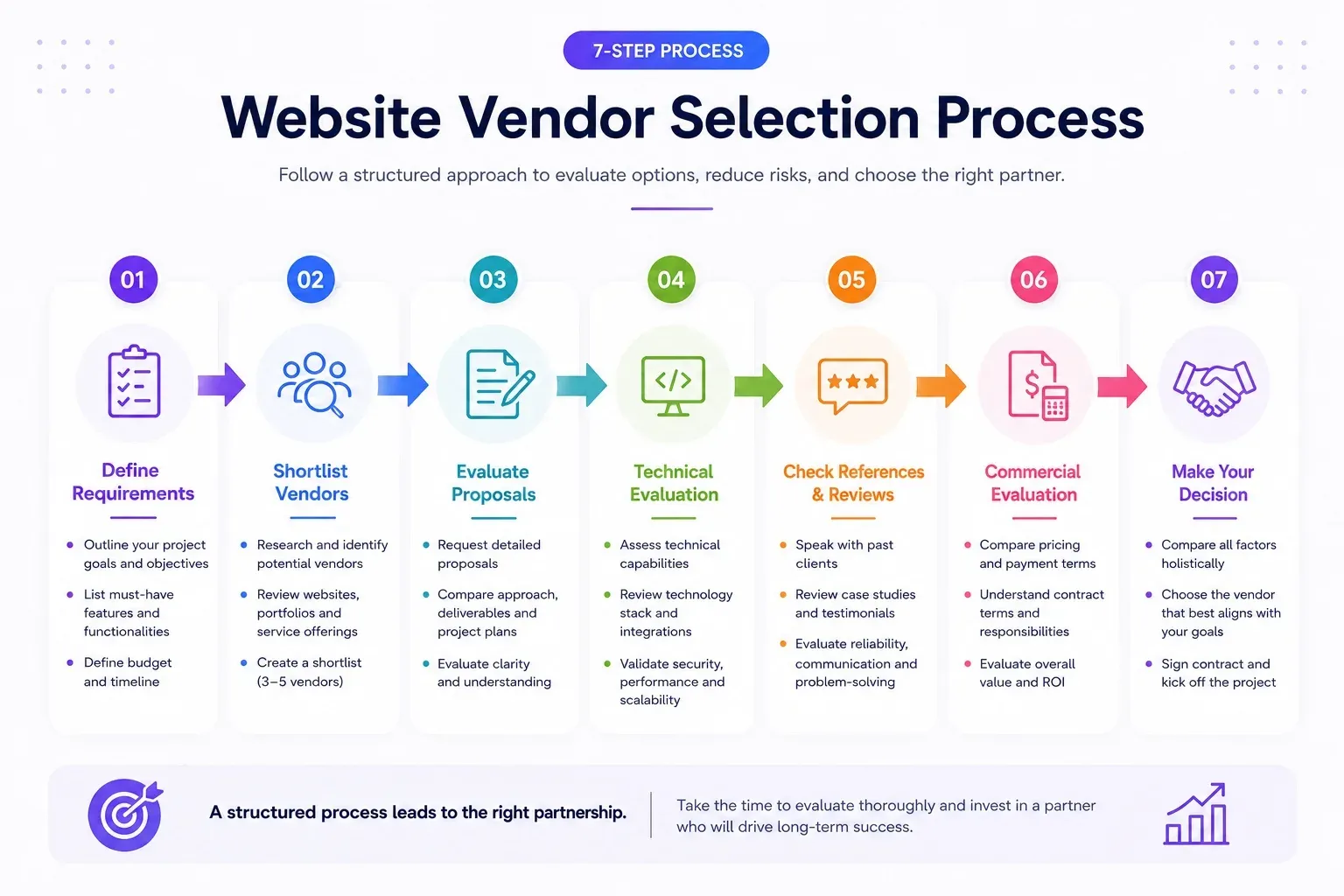
A practical selection process should begin with clearly defined requirements, followed by vendor shortlisting, proposal evaluation, technical review, reference checks, commercial evaluation, and final decision-making.
Conclusion
Selecting the right website development company requires careful evaluation of experience, technical capability, user experience expertise, security practices, project delivery methods, support services, and commercial value.
By using a structured evaluation framework, organizations can reduce project risk, improve outcomes, and maximize return on investment.
A website should be viewed as a strategic business asset. Choosing the right development partner is one of the most important decisions in ensuring its success.
Need Expert Guidance?
If you are planning a website revamp, e-commerce platform, customer portal, educational portal, or digital transformation initiative, Konekt can help you define requirements, evaluate options, and implement scalable digital solutions that deliver measurable business results.
Contact our team today to discuss your project requirements.
- Website Development
- Digital Transformation
- Web Design
- Vendor Selection
- Website Evaluation
- Sri Lanka
- Business Technology
- Digital Strategy