See what effective ecommerce website design in Sri Lanka gets right, from mobile UX and product pages to payments, delivery and retail integrations.
Great ecommerce website design is not a beauty contest. The strongest online stores help shoppers find the right product, understand the offer, trust the seller, and complete a purchase without unnecessary effort.
That standard matters in Sri Lanka, where a storefront must do more than present products attractively. It must work well on mobile, support familiar payment methods, explain island-wide delivery, handle promotions clearly, and connect the customer experience to stock, fulfilment, loyalty, and reporting behind the scenes.
This guide examines the practical patterns that set effective Sri Lankan ecommerce websites apart. It is not a ranking of individual stores. Instead, it is a benchmark that retail and ecommerce teams can use when planning a new website or improving an existing one.
What Good Ecommerce Website Design Actually Does
An ecommerce website has two jobs at the same time:
- Help the customer make a confident buying decision.
- Help the business process that decision accurately and efficiently.
A store can look polished and still fail at both. Shoppers may struggle to navigate the catalogue, understand delivery charges, select a size, or finish payment. Staff may then have to correct stock errors, confirm orders manually, re-enter delivery details, or reconcile transactions across disconnected systems.
The best ecommerce website design therefore brings together four qualities:
- Clarity: customers immediately understand what the store sells and how to move through it.
- Confidence: product information, policies, payment methods, and fulfilment expectations reduce doubt.
- Convenience: search, filtering, mobile controls, checkout, and account features remove effort.
- Operational fit: the website connects cleanly with the systems and teams that fulfil the order.
These qualities matter more than visual novelty. A distinctive brand experience is valuable, but it should support the buying journey rather than compete with it.
1. The Storefront Is Designed Mobile-First
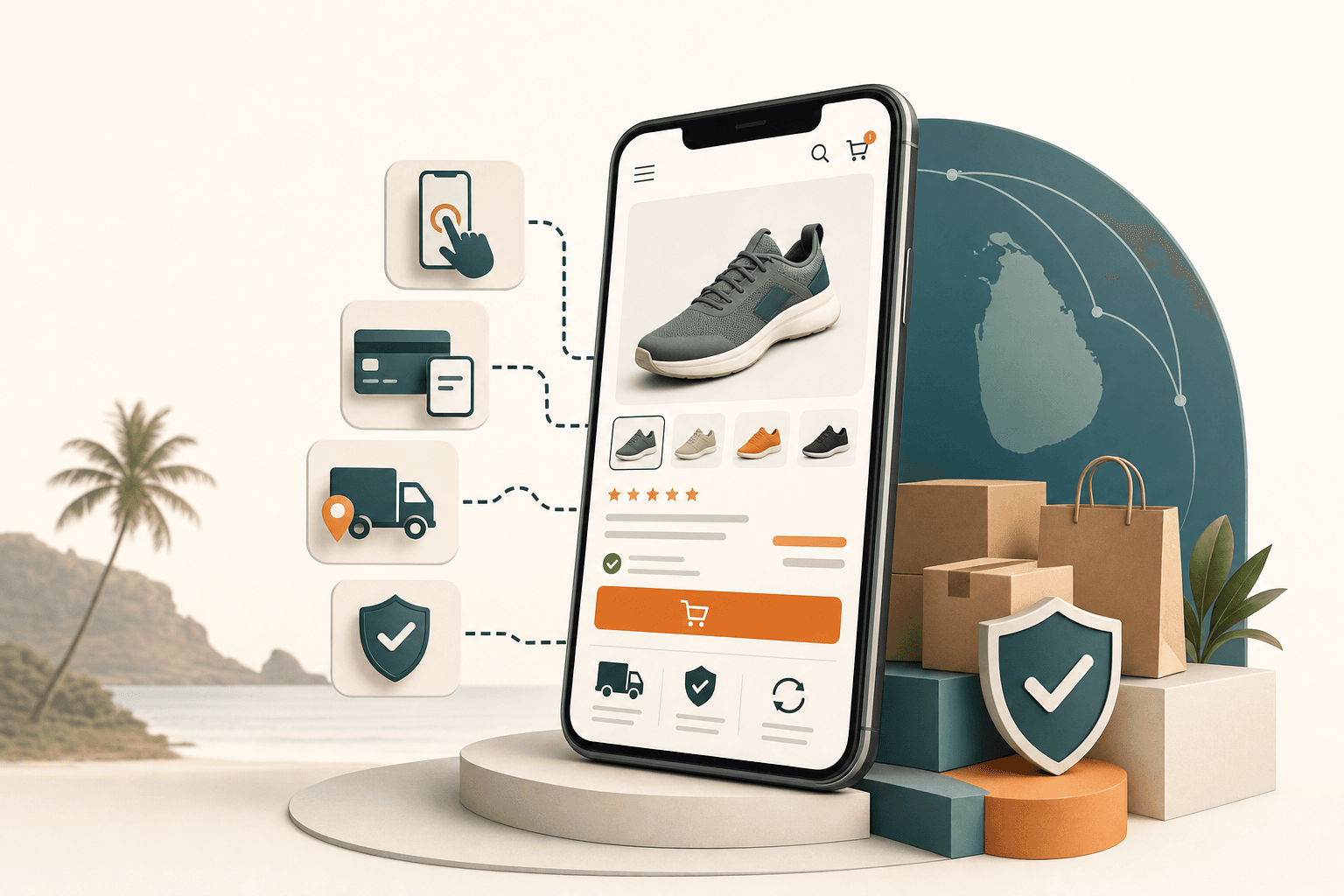
Mobile-first design is more than making a desktop layout fit a smaller screen. It means planning the shopping journey around touch controls, limited space, intermittent connectivity, and customers who may compare several products quickly.
Make the next action obvious
On mobile, customers should be able to:
- open the main product categories without hunting;
- use search with one thumb;
- filter and sort without covering the entire screen;
- see the product name, price, offer, and primary image clearly;
- choose variants without tiny controls;
- add to cart without scrolling back and forth; and
- return to the cart or checkout without losing their place.
The primary action should remain visually clear. Promotional banners, chat widgets, app prompts, cookie notices, and sticky menus should not compete for the same small area.
Protect performance
Large images, multiple tracking scripts, oversized apps, and animation can make a storefront feel slow. That cost is especially visible on mobile connections. Strong ecommerce teams treat performance as a design requirement from the first wireframe, not a technical clean-up task before launch.
That means setting image standards, limiting unnecessary scripts, loading content in the right order, and testing real category, product, cart, and checkout pages on common devices.
2. Navigation Reflects How Customers Shop
An internal product hierarchy may make sense to the merchandising team while confusing customers. Effective ecommerce websites organise the catalogue around the language and decisions shoppers actually use.
Build categories around buying intent
A fashion retailer might need navigation by audience, product type, occasion, size, collection, and new arrivals. An electronics store may need category, brand, use case, specification, and compatibility. A grocery or FMCG store may need repeat-purchase shortcuts, pack size, dietary filters, and availability by location.
The right structure depends on the catalogue. What matters is that customers can narrow a large choice set without knowing the company's internal terminology.
Make search useful, not merely present
Site search should account for product names, brands, common spelling variations, categories, model numbers, and useful attributes. A no-results page should offer alternatives rather than end the journey.
Retail teams should review actual search data after launch. Repeated searches with poor results often expose missing synonyms, unclear categories, unavailable products, or demand the catalogue does not yet serve.
3. Product Pages Answer the Buying Questions
The product page is where interest becomes a decision. High-performing stores give customers enough information to buy without forcing them to contact support for basic answers.
An effective product page typically makes the following easy to find:
- price and any genuine promotional price;
- availability;
- selectable variants such as size, colour, or pack;
- clear, consistent product images;
- the essential description and specifications;
- size, compatibility, or usage guidance where relevant;
- delivery or collection expectations;
- return and exchange information;
- accepted payment methods; and
- a clear add-to-cart action.
Show information in the order customers need it
Not every detail deserves equal visual weight. The first screen should answer the immediate questions: What is this? Is it right for me? What does it cost? Can I get it? What should I do next?
Supporting details can sit lower on the page in well-labelled sections. This creates a product page that is useful without becoming visually dense.
Design for real catalogue complexity
If a product has many colours, sizes, bundles, or location-specific options, the interface should make unavailable combinations obvious before the customer reaches checkout. This reduces frustration and prevents avoidable service queries.
For specialised catalogues, rules may need to go further. Konekt's Gateway College online bookstore, for example, uses student identification and grade-level book lists to guide parents to the correct products. The principle is broadly useful: remove the decisions the system can make reliably for the customer.
4. Trust Is Built Into the Buying Journey
Trust should not depend on a single badge in the footer. It grows through consistent evidence across the store.
Customers look for signs that the business is real, the product will match the description, payment will be handled securely, delivery expectations are credible, and help will be available if something goes wrong.
Useful trust elements include:
- clear business and contact information;
- consistent product photography and descriptions;
- visible delivery, return, refund, and privacy policies;
- realistic stock and delivery messages;
- verified reviews or other appropriate social proof;
- transparent payment options;
- secure checkout behaviour; and
- order confirmation and tracking after purchase.
Avoid vague claims and artificial urgency. Trust is easier to lose than to build, and misleading countdowns or permanently discounted prices can undermine an otherwise professional experience.
5. Payments Fit the Sri Lankan Customer
Checkout design must reflect the payment methods customers can and want to use. A technically working gateway is only one part of that experience.
Before the final payment step, customers should understand:
- which cards, gateways, bank options, instalment methods, or cash-on-delivery arrangements are available;
- when the final total will be confirmed;
- whether any payment method has conditions;
- what happens if a payment fails; and
- how a successful order will be acknowledged.
The payment interface should preserve context. If a transaction fails, the customer should receive a clear next step without having to rebuild the cart.
Finance and operations also need a reliable way to match gateway transactions to website orders. Konekt's Fashion Bug ecommerce transformation included payment reconciliation automation that links Shopify order numbers with gateway reports. This illustrates an important benchmark: good checkout design continues into accurate back-office processing.
6. Delivery Information Appears Before Checkout
Delivery uncertainty is a common reason for hesitation. Customers should not have to reach the final checkout screen to learn whether an area is served, how charges are calculated, or when an order might arrive.
Strong ecommerce websites set expectations early through:
- concise delivery messages on product or cart pages;
- location-aware availability where required;
- understandable delivery charges;
- collection options where offered;
- cut-off times for time-sensitive products;
- order tracking; and
- clear instructions for delayed, changed, or returned orders.
The right rules depend on the business. A fashion retailer, grocery store, flower delivery service, and B2B supplier have different fulfilment constraints. Those constraints should shape the website experience rather than remain hidden in an internal process.
Delivery also needs an operational connection. In Konekt's Thilakawardhana ecommerce project, the Shopify store was connected with delivery and loyalty systems while the platform was designed for higher traffic and better reliability. The customer-facing journey and the operational workflow were treated as one system.
7. Promotions Are Easy to Understand
Retail promotions can become complicated quickly: percentage discounts, fixed discounts, bundles, free gifts, coupon codes, loyalty rewards, instalment offers, and delivery promotions may overlap.
An effective ecommerce design explains:
- which products qualify;
- whether a code is required;
- the promotion period;
- exclusions or minimum values;
- whether offers can be combined; and
- the saving applied in the cart.
Customers should not have to calculate the offer themselves. The product page and cart should show consistent prices, and any condition should be visible before checkout.
Merchandising teams also need manageable controls. A campaign that requires developer intervention for every banner, collection, or landing page will slow the business down. The content model and platform configuration should support the retailer's actual campaign rhythm.
8. The Website Connects With Retail Operations
The strongest ecommerce websites are not isolated storefronts. They exchange reliable information with the systems responsible for stock, orders, customer relationships, delivery, finance, and reporting.
Depending on the retailer, useful connections may include:
- ERP or inventory management;
- point-of-sale systems;
- warehouse or fulfilment platforms;
- payment gateways and reconciliation workflows;
- courier and delivery management;
- customer loyalty;
- CRM and marketing automation;
- analytics and product reporting; and
- customer service tools.
Not every retailer needs every integration. The important step is to map the order lifecycle before choosing apps or development work.
Ask where product information originates, when stock is reserved, who approves fulfilment, how tracking is created, where returns are recorded, and how finance closes the transaction. Those answers reveal which connections are essential and which can wait.
Konekt's Shopify development services combine storefront work with payment, ERP, POS, supplier, loyalty, automation, and delivery integrations. This integration-first view helps ensure design decisions can survive day-to-day retail operations.
9. Accessibility and Local Content Are Part of Quality
An ecommerce store should remain usable for customers with different devices, abilities, languages, and levels of digital confidence.
Practical accessibility improvements include readable text, sufficient colour contrast, descriptive form labels, keyboard-friendly controls, meaningful image alternatives, clear error messages, and interfaces that do not rely on colour alone.
Localisation should also be planned intentionally. If Sinhala or Tamil content is required, teams need to decide which parts of the catalogue and customer journey will be translated, who maintains those versions, and how product data stays consistent. A partially localised checkout can be more confusing than a clearly managed language experience.
10. Decisions Are Measured After Launch
Launch is the start of ecommerce improvement, not the end. Strong teams use evidence to decide what to change.
A practical measurement plan can include:
- product discovery through search and navigation;
- product-page engagement;
- add-to-cart rate;
- checkout completion;
- payment failures;
- device and browser performance;
- delivery-related support queries;
- returns caused by unclear product information; and
- repeat purchase or loyalty participation.
Numbers need context. A drop in checkout completion may come from a payment problem, unexpected delivery charges, a confusing field, or low-quality traffic. Combine analytics with search data, customer service themes, staff feedback, and usability testing before deciding on a redesign.
An Ecommerce Website Design Benchmark for Your Store
Use these questions to review an existing store or compare proposals for a new one.
Customer experience
- Can a first-time visitor understand the offer within seconds?
- Can shoppers find a product through both navigation and search?
- Do filters match the way customers compare products?
- Do product pages answer the important buying questions?
- Is the mobile journey comfortable on a real device?
Trust and conversion
- Are prices, promotions, payment options, delivery, and returns clear?
- Does checkout remove unnecessary fields and distractions?
- Can customers recover from stock, validation, or payment errors?
- Are order confirmations and tracking messages useful?
Operations
- Where do product, price, and stock data originate?
- How are orders passed to fulfilment and delivery?
- Can finance reconcile payments with orders?
- Can staff manage products and campaigns without unnecessary technical work?
- Are integrations monitored when data fails to sync?
Growth
- Can the platform handle larger catalogues and campaign traffic?
- Can the team create landing pages, collections, and promotions efficiently?
- Are analytics events and reporting requirements defined?
- Is there a roadmap for optimisation after launch?
Build the Store Around the Whole Buying Journey
What Sri Lanka's best ecommerce websites do differently is not a single design trend. They reduce uncertainty at every stage, from product discovery to payment, delivery, and after-sales service. They also connect the visible storefront with the operational systems that keep promises to the customer.
When planning a new store, begin with the buying journey and the order lifecycle. Define the decisions customers need to make, the information teams need to exchange, and the outcomes the business needs to measure. Then select the platform, design system, and integrations that support that model.
Konekt builds ecommerce experiences and connected retail systems for Sri Lankan businesses across Shopify, WooCommerce, and custom requirements. Book a consultation with Konekt to review your storefront, operational workflows, and the practical roadmap for your next ecommerce website.
Frequently asked questions
What makes a good ecommerce website design?
A good ecommerce website makes products easy to find, explains the offer clearly, builds trust, works smoothly on mobile, and removes friction from checkout. It should also connect reliably with the stock, payment, fulfilment, delivery, and reporting processes behind the purchase.
Which ecommerce platform is best for a Sri Lankan business?
The right choice depends on catalogue complexity, campaign needs, integrations, internal skills, budget, and growth plans. Shopify can suit retailers seeking a managed, scalable platform, while WooCommerce can work well when WordPress flexibility and deeper content integration matter. Custom development is justified when essential workflows cannot be handled cleanly by a standard platform. Konekt's Shopify versus WooCommerce guide explains the trade-offs in more detail.
What should a Sri Lankan ecommerce checkout include?
Checkout should present the final order clearly, request only necessary information, support appropriate local payment methods, explain delivery charges and expectations, and give customers a clear recovery path if payment or validation fails.
How often should an ecommerce website be improved?
Improvement should be continuous. Review performance, search behaviour, checkout completion, payment failures, customer service themes, and operational exceptions regularly. Larger design or platform changes should follow evidence of a recurring problem rather than an arbitrary calendar date.