Headless commerce is often presented as the modern answer to every ecommerce limitation. It can give a retailer far more control over customer experiences, channels and integrations, but it also creates a separate application that must be designed, secured, tested and maintained.
That trade-off matters. A conventional Shopify or WooCommerce store can be the better commercial decision when the business needs a reliable online store, a fast launch and straightforward operations. Headless commerce becomes valuable when a clear business requirement cannot be served well by the standard storefront.
This guide explains how headless commerce works, where it creates value, what it adds to the operating model and how Sri Lankan retail teams can decide whether the extra flexibility is worth the investment.
Key Takeaways
- Headless commerce separates the customer-facing storefront from the commerce engine and connects them through APIs.
- It is most useful when a business needs distinctive customer journeys, multiple digital touchpoints, complex integrations or independent release cycles.
- Headless is not automatically faster, better for SEO or less expensive. Those outcomes depend on architecture, implementation and ongoing ownership.
- Sri Lankan retailers must evaluate local payments, inventory, POS, ERP, delivery and support requirements as part of the architecture decision.
- A phased proof of concept is usually safer than rebuilding the entire customer journey at once.
What Is Headless Commerce?
Headless commerce is an ecommerce architecture in which the front-end experience is separated from the back-end commerce platform.
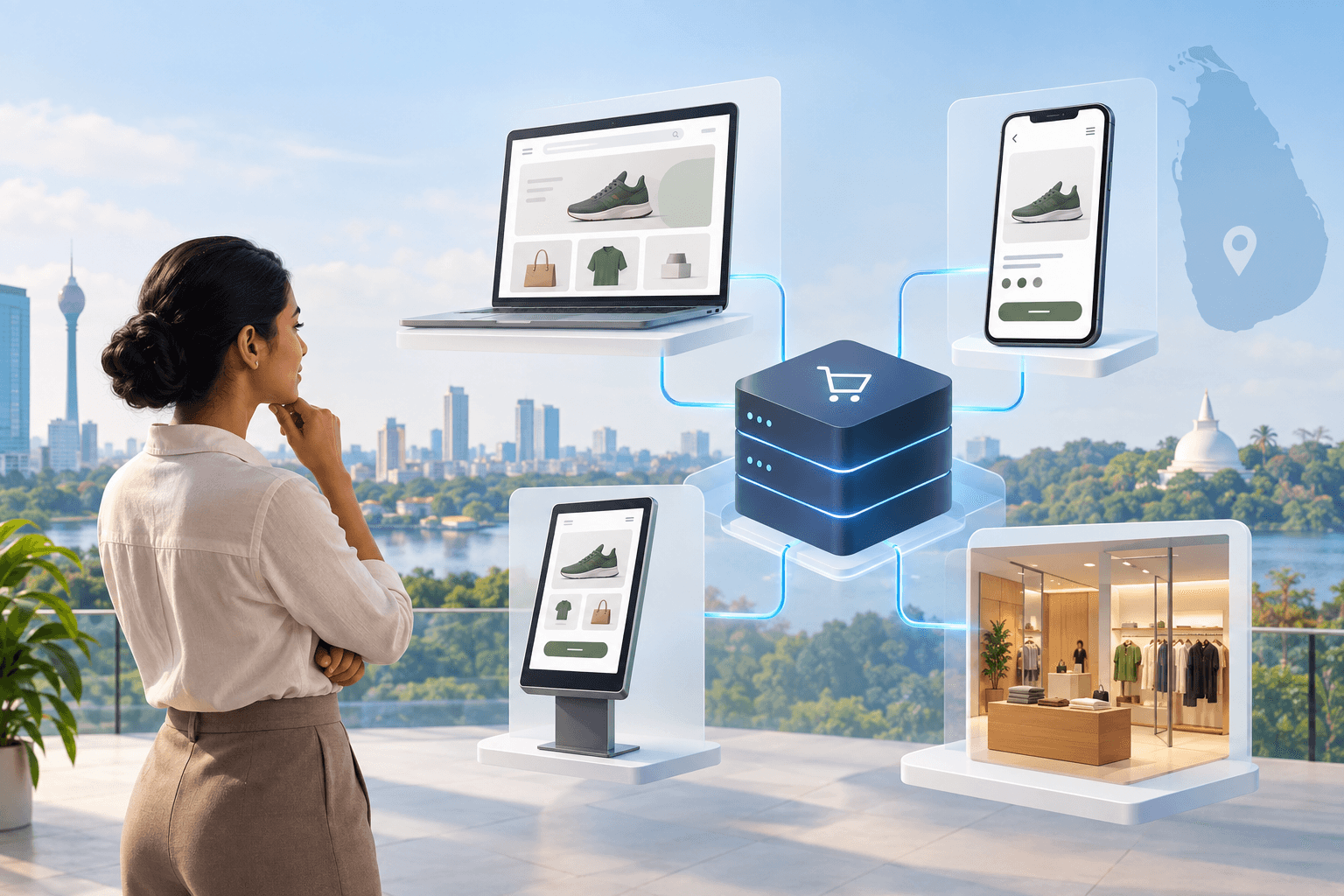
The front end is everything a customer sees and uses: navigation, category pages, product pages, content, search, cart interactions and account experiences. It may be a website, mobile app, in-store kiosk or another digital channel.
The back end handles commerce functions such as products, prices, inventory, customers, promotions, checkout and orders. Shopify, BigCommerce, Adobe Commerce or a custom commerce service can fill this role.
Application programming interfaces, or APIs, move data and actions between the two layers. When a customer opens a product page, for example, the front end requests the relevant product, price and availability data from the commerce engine. When the customer adds an item to the cart, another API request updates the cart.
In a traditional ecommerce implementation, the platform provides both the commerce engine and the storefront. In a headless implementation, the business builds or adopts a separate storefront while retaining the platform's commerce capabilities.
Headless Commerce Is Not the Same as Composable Commerce
The two terms are related but not interchangeable.
Headless commerce separates the experience layer from the commerce back end. Composable commerce goes further by breaking capabilities such as search, content management, product information, promotions and checkout into independently selected services.
A retailer can therefore run a headless storefront without adopting a fully composable stack. This distinction matters because every additional service creates another contract, integration, failure point and area of technical ownership.
Headless Commerce vs Traditional Ecommerce
Neither model is universally better. The right choice depends on the experience the business must deliver and the complexity it is prepared to operate.
| Decision factor | Traditional storefront | Headless storefront |
|---|---|---|
| Initial launch | Usually faster because themes and platform features are already connected | Usually slower because the storefront and integrations require separate development |
| Experience control | Strong within the platform's theme and extension model | High control over interface, content and interaction design |
| Team dependency | Merchants can often manage more changes without developers | Engineering support is commonly required for storefront changes and releases |
| Multiple channels | Depends on the platform's native capabilities and apps | One commerce engine can serve web, apps, kiosks and other interfaces |
| Maintenance | More of the storefront stack is managed together | The business owns a separate front end, hosting, monitoring and API reliability |
| Total cost | Lower for standard requirements in many cases | Higher when custom engineering and ongoing operation are included |
A standard storefront remains a strong option for many retailers. Shopify themes can support custom sections, apps, integrations and strong mobile experiences without separating the front end. WooCommerce offers deeper code-level flexibility for businesses already operating on WordPress. Konekt's Shopify vs WooCommerce guide explains the practical differences between those two conventional approaches.
When Headless Commerce Can Create Real Value
A headless build should solve a defined constraint. The following situations can justify serious evaluation.
You Need Several Customer-Facing Channels
A retailer may want one commerce back end to support a website, native mobile app, in-store kiosk, sales-associate interface and other touchpoints. A headless architecture can let those interfaces reuse product, price, inventory and cart services instead of duplicating commerce logic in every channel.
That does not automatically create a seamless experience. The team still needs consistent identity, customer data, promotions and order rules across channels. The advantage is that the architecture can provide a common foundation.
Your Buying Journey Cannot Fit a Standard Theme
Some businesses need product configuration, guided selling, immersive content, unusual subscription flows, account-specific catalogues or complex B2B journeys. If the platform's theme model forces repeated workarounds, a custom front end may provide a cleaner long-term solution.
The requirement must be specific. “We want a unique website” is not enough. A useful business case identifies the exact customer task, the platform constraint, the expected commercial effect and the cost of maintaining the custom experience.
Content and Commerce Must Work Closely Together
Content-rich retailers may need editorial pages, product discovery and campaign experiences to be managed across markets or brands. A headless content management system can give content teams an independent publishing layer while the commerce platform remains responsible for transactions.
This setup can work well, but responsibilities must be explicit. The team should know where product descriptions, campaign content, navigation, metadata and translations are managed so information does not become duplicated or inconsistent.
Integration Complexity Has Outgrown the Storefront
A large retailer may need the storefront to work with an ERP, product information management system, CRM, POS, warehouse platform, loyalty service, payment gateways and delivery providers. Headless commerce can support an API-led model in which the front end consumes the information it needs from the correct systems.
However, separating the storefront does not repair poor source data or undefined ownership. Before changing architecture, establish which system owns each data type and how errors will be detected, retried and reconciled.
Teams Need Independent Release Cycles
In a tightly coupled implementation, front-end changes may depend on platform templates, release processes or back-end work. A headless model can allow a customer-experience team to release the storefront independently from the commerce engine.
That benefit is strongest when the organisation has mature product, engineering, testing and deployment practices. Without those capabilities, another release pipeline can slow delivery instead of accelerating it.
When You Should Probably Stay With a Traditional Storefront
Headless commerce is unlikely to be the best first step when:
- The business needs to launch quickly with standard catalogue, cart and checkout requirements.
- The main problems are weak product data, unclear fulfilment, poor merchandising or manual operations.
- A well-built theme can deliver the required experience.
- There is no team or partner responsible for the front end after launch.
- The budget covers the initial build but not monitoring, maintenance and continuous improvement.
- The expected benefit cannot be tied to a customer, operational or growth constraint.
- Existing integrations are unreliable and have not been stabilised.
Retailers sometimes look to architecture for a solution to operating problems. A new front end will not correct inaccurate stock, slow fulfilment, inconsistent pricing or unclear customer-service processes. Konekt's ecommerce website planning guide can help teams document those fundamentals before selecting a platform or architecture.
What a Headless Commerce Stack Includes
A production headless storefront needs more than a visual front end and an ecommerce subscription. A typical stack may include:
- A commerce engine for catalogue, pricing, cart, checkout and orders
- A custom web front end built with a modern framework
- A content management system for editorial and campaign content
- Search and filtering services
- Product information management where catalogue complexity requires it
- Customer identity and account services
- Analytics, consent and marketing integrations
- Hosting, content delivery, security controls and monitoring
- Middleware or integration services connecting ERP, POS, CRM, inventory and fulfilment
- Automated tests and deployment pipelines
Shopify can support a headless model through its APIs and headless tooling while retaining Shopify for core commerce. Other platforms provide similar API-first capabilities. The platform decision should follow the business requirements, not precede them.
Konekt's Shopify development services cover custom storefronts and integrations, while its software and API development capability is relevant when the project needs a custom experience layer or integration services.
Sri Lankan Requirements to Resolve Early
The architecture must work with the retailer's actual operating environment. For a Sri Lankan business, the following questions should be answered during discovery.
Payments and Reconciliation
Confirm which payment methods are required, whether each provider supports the proposed checkout model and how successful, failed, delayed and duplicate payment notifications will be handled.
Also map reconciliation. The finance team needs a reliable way to connect gateway settlements, transaction fees, refunds and orders. A polished custom storefront does not reduce the need for clear payment records.
Inventory, POS and ERP
Define the source of truth for products, stock, prices, promotions, customers and orders. Decide how frequently data must update and what happens when an API or internal system is unavailable.
For multi-location retail, document stock reservation, transfers, click-and-collect, returns and branch-level availability. Konekt's retail digital transformation solutions show how ecommerce, POS, ERP, loyalty, automation and delivery fit into one operating model.
Delivery and Fulfilment
Specify delivery zones, charges, service levels, pickup rules and the systems used by warehouses, stores and delivery teams. Determine how an order moves from confirmed payment to picking, dispatch, tracking and proof of delivery.
A headless front end may present these options more flexibly, but it still depends on accurate rules and dependable integrations behind the experience.
Mobile Performance and Network Conditions
Test the complete purchase journey on real mobile devices and realistic network conditions. A headless architecture gives developers more performance control, but it also allows a poorly designed front end to become heavy and slow.
Set measurable performance budgets for pages, images, scripts and API calls. Monitor actual customer experiences after launch instead of treating the launch audit as permanent proof of speed.
Ownership and Support
Decide who will own:
- Front-end code and hosting
- Commerce-platform configuration
- APIs and middleware
- Security updates and dependency upgrades
- Incident response and monitoring
- Content and merchandising workflows
- Regression testing
- Vendor coordination
If each layer has a different supplier, document escalation paths and service responsibilities. Otherwise, an integration failure can become a debate about ownership while customers are unable to buy.
A Practical Headless Commerce Readiness Test
Score the business against these questions before requesting a build.
Business Case
- Which customer or operational constraint requires a separate front end?
- What measurable result should improve?
- Is the value large enough to justify added engineering and operating cost?
Experience Requirements
- Are the required journeys impossible or unreasonably difficult in the current platform?
- Must the same commerce services support several customer-facing channels?
- Does the business need a distinctive content-and-commerce model?
Technology Readiness
- Are APIs available and reliable for the commerce platform and connected systems?
- Are product, price, inventory and customer-data owners clearly defined?
- Can the team monitor failures and reconcile missing transactions?
Organisational Readiness
- Is there a product owner who can prioritise the roadmap?
- Is engineering capacity available after launch?
- Can content, merchandising, operations and IT work within the new workflow?
- Has the business budgeted for ongoing maintenance, not only implementation?
If the answers are mostly uncertain, begin with discovery and a small proof of concept. The readiness work is valuable even if the final recommendation is to keep a traditional storefront.
How to Plan a Headless Commerce Project
1. Define the Decision, Not the Technology
Write down the commercial problem, affected users, current constraint and required outcome. Separate essential needs from attractive possibilities.
2. Map the Current Commerce Journey
Document product discovery, pricing, stock checks, cart, checkout, payment, order creation, fulfilment, returns and support. Identify every system and manual handoff.
3. Choose a Thin First Release
Start with a bounded customer journey, market, brand or page type. Avoid replacing every channel and integration simultaneously unless a genuine platform deadline makes that unavoidable.
4. Design API Contracts and Failure Behaviour
Specify the data required by each interface, expected response times, authentication, caching, rate limits and error handling. Decide what the customer sees when inventory, pricing, search or another dependency is unavailable.
5. Protect SEO During Migration
Preserve valuable URLs where possible. Prepare redirects, canonical rules, metadata, structured data, XML sitemaps and server-rendering requirements before launch. Test crawlability and indexation in a staging environment that cannot accidentally be indexed.
Headless does not guarantee better SEO. Search performance depends on accessible content, stable URLs, fast rendering, correct technical signals and useful pages.
6. Test the Whole Transaction
Test beyond page design. Cover product rules, promotions, account states, payment outcomes, inventory updates, order creation, customer messages, cancellations, refunds and returns. Include peak-load and dependency-failure scenarios.
7. Release in Phases and Measure
Use controlled rollout where possible. Track conversion, page performance, errors, failed searches, cart failures, payment exceptions and operational workload. Compare results with a reliable pre-launch baseline.
Common Headless Commerce Mistakes
Treating Headless as a Design Upgrade
A custom front end is an architectural commitment. If the requirement can be met with a better theme, improved content or focused integration, headless may add cost without adding meaningful value.
Assuming It Will Automatically Be Faster
Performance depends on data fetching, caching, code size, images, third-party scripts and hosting. The architecture provides control, not a guaranteed outcome.
Recreating Platform Features From Scratch
Before custom-building search, accounts, promotions or checkout-related experiences, identify what the commerce platform already provides and what must remain within supported boundaries.
Ignoring Merchant Workflows
A beautiful storefront can leave content and merchandising teams dependent on developers. Prototype the admin and publishing workflow as carefully as the customer interface.
Underestimating Ongoing Cost
Include hosting, monitoring, security, dependency upgrades, API changes, testing and continuous development in the total cost of ownership. The launch budget is only the beginning of the operating model.
Choose the Simplest Architecture That Meets the Business Need
Headless commerce can be a powerful foundation for retailers that need differentiated experiences, several digital channels and deep system integration. Its value comes from solving those requirements, not from being newer or more technically sophisticated.
The best architecture is the simplest one that can support the customer experience, operations and growth plan without creating unnecessary ownership risk.
Konekt works across ecommerce, Shopify, custom software and retail integrations. Book a consultation to review your current stack, customer journeys and integration requirements before committing to a headless build or conventional replatforming project.