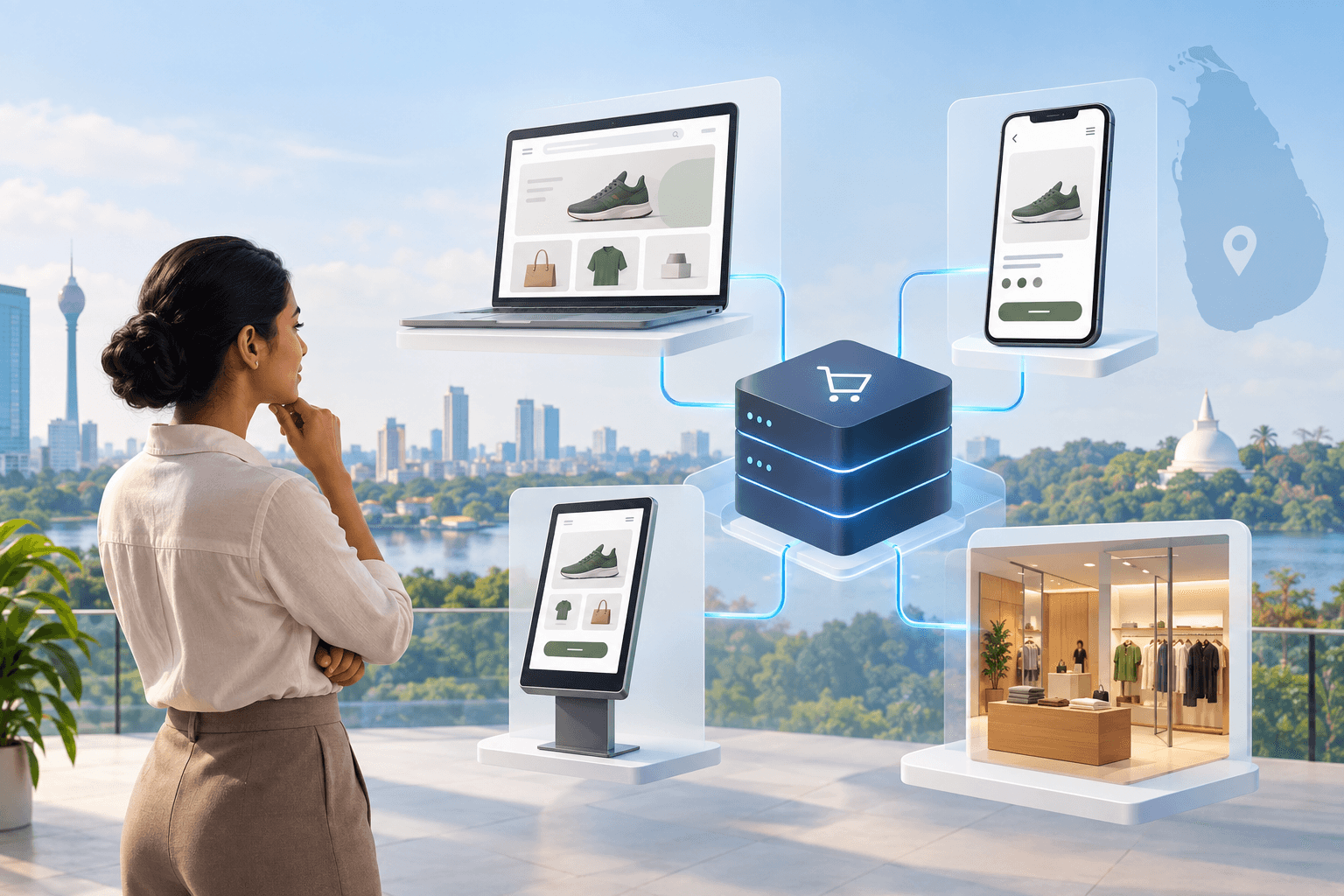
Retailers rarely struggle because they lack sales channels. The real problem is that those channels often operate as separate businesses.
The ecommerce store has one stock count. The point-of-sale system has another. Customer details sit in a loyalty platform, delivery updates live in spreadsheets or messaging threads, and finance teams reconcile transactions after the fact. Each new channel adds reach, but it also adds more places for data to drift.
A sound omnichannel commerce architecture connects these systems around shared rules for products, inventory, customers, orders, payments and fulfilment. It gives customers a consistent experience while helping teams operate from reliable information.
This guide explains the building blocks, design decisions and phased roadmap Sri Lankan retailers can use to move from disconnected channels to connected commerce.
What Is Omnichannel Commerce Architecture?
Omnichannel commerce architecture is the technical and operational design that allows retail channels and business systems to work together.
It covers the connections between:
- Ecommerce storefronts such as Shopify or WooCommerce
- Physical-store point-of-sale systems
- Enterprise resource planning systems
- Product and inventory records
- Order and warehouse management
- Payment gateways
- Customer relationship management and loyalty platforms
- Delivery and fulfilment tools
- Analytics and reporting
The goal is not simply to make every system exchange data. The goal is to define which system owns each type of data, when updates must happen, how errors are handled and how customer journeys continue across channels.
For example, a customer may check stock online, purchase from a physical store, earn loyalty points, request delivery and later return the item through another location. The experience feels simple only when inventory, customer, order, payment and return data move through the architecture correctly.
Omnichannel, Multichannel and Unified Commerce
These terms are often used interchangeably, but they describe different levels of connection.
Multichannel commerce
A multichannel retailer sells through more than one channel, such as a physical store, website, marketplace and social platform. The channels may share a brand while operating with separate data and processes.
Omnichannel commerce
Omnichannel commerce connects customer journeys across channels. Customers can move between online and offline touchpoints with consistent information, service and context.
Unified commerce
Unified commerce takes the connection further by bringing channels and core back-office functions onto a shared platform or central data model. It can reduce integration complexity, although it may not suit every retailer's existing systems or specialist requirements.
The right target depends on business needs. A growing retailer may achieve strong omnichannel operations by integrating a reliable POS, ecommerce platform, loyalty system and delivery workflow. A larger enterprise may need an ERP, order management system, data platform and several specialised applications.
The Core Layers of an Omnichannel Commerce Architecture
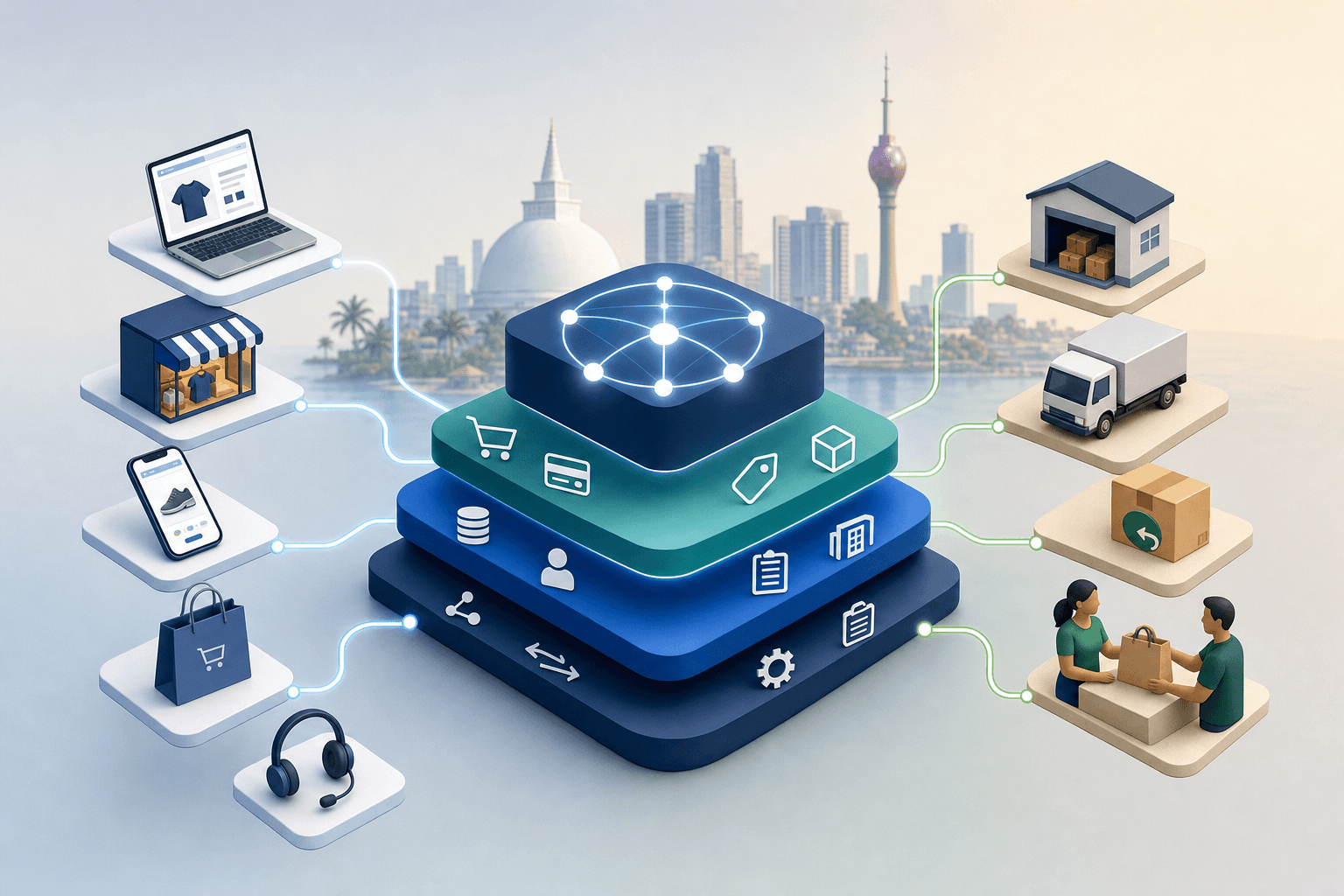
A useful architecture separates customer-facing channels from the systems that manage transactions, data and fulfilment.
1. Customer and sales channels
These are the places where customers discover, buy and receive service:
- Ecommerce websites
- Physical stores and POS terminals
- Mobile apps
- Marketplaces
- Social-commerce channels
- Customer-service desks
- Call centres or assisted ordering
Channels should not each become an independent source of product, price, inventory or customer truth. They should consume governed data and send transactions back through agreed workflows.
2. Commerce and transaction layer
This layer handles carts, checkout, promotions, payments and orders. Depending on the retailer, the centre may be an ecommerce platform, a retail commerce suite or an order management system.
The important decision is not the brand of platform. It is whether the platform can support the required channels, integrations, transaction volumes, operational rules and future changes.
3. Systems of record
Every important data domain needs a clearly named owner. A practical ownership model may look like this:
- Product master: ERP, product information management system or commerce platform
- Inventory: ERP, POS, warehouse system or inventory service
- Customer profile: CRM, customer data platform or commerce platform
- Order: commerce platform or order management system
- Payment record: payment gateway plus finance or ERP records
- Loyalty balance: loyalty platform
- Delivery status: delivery management or carrier system
There is no universal assignment. What matters is that teams agree on one authoritative owner for each domain and document which systems may update it.
4. Integration and orchestration layer
This layer moves and transforms data between systems. It may use direct APIs, webhooks, middleware, an integration platform or event-driven services.
It should manage more than successful data transfers. A dependable integration design also handles:
- Authentication and access control
- Data mapping and validation
- Duplicate prevention
- Retries and timeouts
- Failed-message queues
- Logging and monitoring
- Version changes
- Reconciliation
Without these controls, integrations can appear healthy while silently creating stock, customer or order discrepancies.
5. Fulfilment and service layer
Omnichannel promises depend on operational capabilities. The architecture may need to support:
- Buy online and collect in store
- Ship from a store or central warehouse
- Transfer stock between locations
- Deliver through in-house or third-party fleets
- Return online purchases to a physical location
- View the full order history during customer support
- Earn and redeem loyalty benefits across channels
A retailer should select these journeys before designing integrations. Otherwise, technical teams may connect systems without enabling the experiences that customers and staff actually need.
6. Data and analytics layer
Connected commerce should produce a consistent view of sales, inventory, customers and fulfilment.
Useful reporting may include:
- Revenue and margin by channel
- Inventory availability and stock ageing
- Order cycle time and fulfilment exceptions
- Cross-channel customer behaviour
- Promotion and loyalty performance
- Returns by product, location and channel
- Payment and settlement reconciliation
Analytics becomes trustworthy only when definitions are shared. “Available inventory,” for example, must account for stock on hand, reservations, pending returns, damaged items and safety buffers in the same way across reports.
Five Data Flows to Design First
Trying to connect every system at once creates unnecessary risk. Start with the flows that have the greatest effect on revenue and daily operations.
Inventory availability
Define how sales, returns, reservations, transfers and cancellations update stock. Decide how quickly each channel needs the new quantity and what happens when a system is temporarily unavailable.
Real-time updates are valuable for fast-moving products and shared inventory. Less urgent catalogue or reporting data may be suitable for scheduled batches.
Product, price and promotion data
Choose where products, variants, categories, prices, tax rules and promotions are maintained. Establish approval rules and effective dates so channels do not display conflicting information.
Order creation and status
Map the complete order lifecycle from checkout to payment, allocation, picking, delivery, cancellation and return. Give each status a precise meaning and define which system is allowed to change it.
Customer and loyalty data
Determine how customer identities are matched across online accounts, store purchases, phone numbers and email addresses. Set consent, access and retention rules before centralising profiles.
Loyalty events should be idempotent, meaning the same transaction cannot award or reverse points twice if a message is retried.
Payments and reconciliation
Document the relationship between the order, payment attempt, gateway reference, refund, settlement and finance record. Automation should make exceptions visible rather than hiding differences behind aggregate totals.
Architecture Decisions That Prevent Expensive Rework
Prefer governed integrations over point-to-point sprawl
A few direct integrations can be sensible. But as systems multiply, a dense network of one-off connections becomes difficult to test and change.
Use shared data contracts, reusable services or an orchestration layer where the same information must reach several destinations. Keep an integration register showing owners, fields, frequency, dependencies and failure procedures.
Use real time selectively
Not every update needs to happen instantly. Real-time processing adds complexity and should be reserved for journeys where delay creates customer or financial risk.
Inventory reservations, payment confirmation and critical order changes often need rapid updates. Product enrichment, historical analytics and some finance exports may run in batches.
Design for failure
External APIs, networks and business systems will sometimes be unavailable. Define:
- How long a channel waits for a response
- Whether the customer can continue
- How transactions are queued
- How many times a message is retried
- Who receives an alert
- How teams reconcile missed updates
Graceful recovery is part of the architecture, not a post-launch support task.
Build security and governance into the design
Limit each integration to the data and actions it needs. Protect credentials, encrypt sensitive data, log privileged changes and separate production access from development access.
Customer and payment information should have clear retention, consent and incident-response procedures. Technology choices should be reviewed alongside the retailer's legal, finance and security requirements.
Avoid unnecessary platform replacement
Omnichannel transformation does not always require replacing every existing system. A stable ERP or POS may remain the system of record while a modern ecommerce layer and integration services improve the customer experience.
The decision should be based on capability, data quality, integration options, supportability and total cost, not on whether a system is old or new.
A Phased Roadmap for Sri Lankan Retailers
Phase 1: Map the current operation
Document channels, systems, data owners, manual handoffs and recurring exceptions. Trace several real customer journeys from start to finish, including cancellations and returns.
Create a baseline using measures such as stock mismatches, reconciliation time, failed orders, delivery delays and customer-service escalations.
Phase 2: Define the target architecture
Select priority customer journeys and assign systems of record. Agree on integration patterns, security controls, monitoring, data definitions and fallback procedures.
This phase should produce a practical architecture diagram, data ownership matrix and rollout plan, not just a platform shortlist.
Phase 3: Build one high-value workflow
Choose a contained workflow with visible operational value. Examples include synchronising inventory between ecommerce and POS, writing online orders back to an existing retail system, or connecting orders to delivery automation.
Pilot with a limited set of locations, products or users. Test normal transactions as well as refunds, cancellations, duplicate messages, outages and delayed updates.
Phase 4: Expand channels and capabilities
Once the foundation is reliable, add fulfilment options, loyalty, customer profiles, marketplaces, analytics and automation. Reuse established data contracts and monitoring wherever possible.
Phase 5: Optimise continuously
Track business and technical performance. Review integration failures, inventory accuracy, order cycle times, adoption and customer outcomes. Retire manual workarounds only after automated flows have proved dependable.
A Buyer Checklist for Omnichannel Commerce Partners
Before choosing a platform or implementation partner, ask:
- Which system will own each important data domain?
- How will online and store inventory stay accurate?
- Can the design work with our current POS, ERP and payment providers?
- Which customer journeys are included in the first phase?
- What uses real-time APIs, webhooks or scheduled batches?
- How are duplicate, delayed and failed messages handled?
- What monitoring and reconciliation tools will operations teams receive?
- How will customer data, permissions and credentials be protected?
- How will releases be tested without disrupting live stores?
- Who owns support when an issue crosses several systems?
- What business measures will demonstrate improvement?
- How can the architecture add new locations, channels or fulfilment models later?
Clear answers reveal whether a proposal addresses the operating model or merely lists software features.
Building for Sri Lankan Retail Operations
Sri Lankan retailers often need to connect international commerce platforms with local payment, POS, ERP and delivery workflows. The architecture should reflect the actual systems used by store, warehouse, finance and customer-service teams.
That means evaluating API quality, settlement processes, connectivity constraints, support responsibilities and the practical ability of staff to manage exceptions. A technically elegant design is not successful if teams still re-enter orders, adjust stock manually or depend on informal messages to resolve failures.
Konekt's retail and ecommerce solutions bring together ecommerce development, ERP and POS integration, loyalty, delivery and commerce automation. Its web development team works with Shopify, WooCommerce and custom applications, while the Gateway College integration case study shows how an online store can be designed around an existing POS as the system of record.
For a broader ecommerce implementation example, see how Konekt connected Shopify with payment, delivery and loyalty capabilities in the Thilakawardhana case study.
Turn Connected Commerce into an Operational Advantage
Omnichannel commerce is not achieved by launching more channels. It is achieved by giving those channels reliable access to the same products, inventory, customers, orders and fulfilment rules.
Start with the journeys that create the most friction today. Define data ownership, build observable integrations, plan for failure and expand only after the foundation works under real operating conditions.
Book a consultation with Konekt to assess your current retail stack and plan an omnichannel commerce architecture that fits your systems, teams and growth priorities.