Compare Shopify pricing in Sri Lanka for 2026, including plans, third-party transaction fees, gateway costs, apps and a practical budget model.
Shopify Pricing in Sri Lanka: The Short Answer
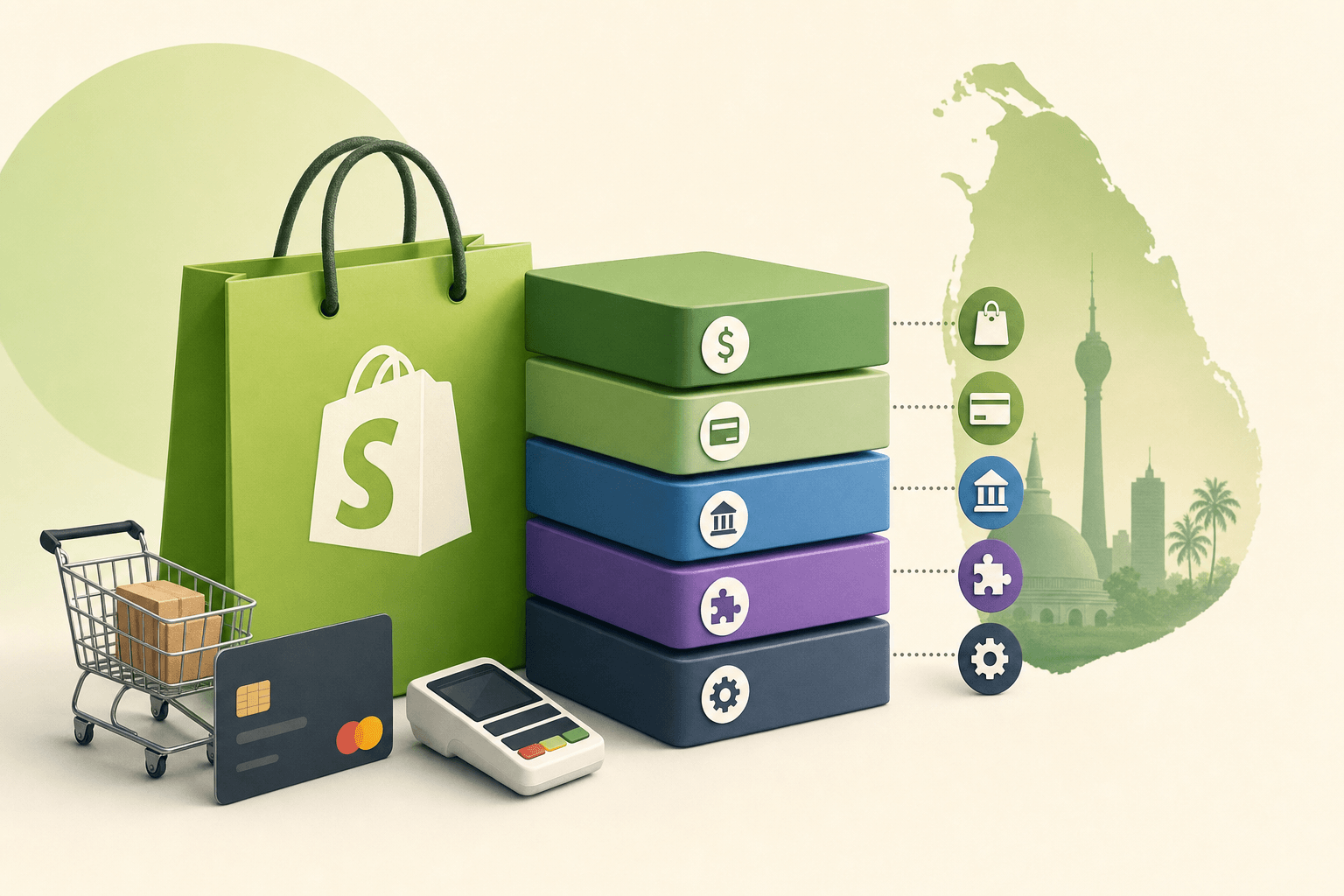
Shopify can be a practical platform for a Sri Lankan online store, but the subscription price is only one part of the budget. A local merchant normally needs to account for five cost layers:
- the Shopify plan
- Shopify's additional fee for using a third-party payment provider
- the payment gateway's own processing fee
- apps, themes and domain costs
- design, development, integrations and ongoing support
That second layer matters especially in Sri Lanka. Shopify Payments is not currently available to Sri Lankan merchants, so stores generally connect a supported third-party gateway. Shopify may then charge an additional transaction fee based on the selected plan, on top of the gateway provider's own charges.
This guide explains the current Shopify pricing structure, shows how those fees interact and gives Sri Lankan retailers a practical way to estimate total cost before committing.
Pricing note: The Shopify prices and third-party transaction rates below were checked on 14 August 2026. Shopify can change prices, promotions and regional terms. Confirm the amount shown for your store on Shopify's official pricing page and in your Shopify admin before making a purchasing decision.
Shopify Plans and Prices in 2026
Shopify's public pricing page currently lists the following US-dollar prices.
Shopify also runs introductory offers from time to time. Treat these as a short-term launch discount, not the long-term cost of operating the store.
Basic
Basic is designed for solo entrepreneurs and smaller teams. It includes the core online store, product and inventory tools, checkout, reports and support. It is usually the sensible starting point for a new Sri Lankan brand that wants to validate demand before adding a larger app stack or complex integrations.
The trade-off is the 2% additional transaction fee when a third-party payment provider processes the order. As sales volume grows, that percentage can become more important than the subscription price.
Grow
Grow is aimed at a small team that needs more operational capacity. Its third-party transaction fee is 1%, half the Basic rate.
For a merchant using monthly billing, Grow costs USD 40 more than Basic but saves one percentage point on third-party transactions. Looking only at those two costs, the extra subscription pays for itself at roughly USD 4,000 in monthly online sales processed through a third-party provider:
USD 4,000 x 1% = USD 40
Features, staff access and reporting needs should still influence the decision. The break-even calculation is a useful check, not the only reason to upgrade.
Advanced
Advanced adds capabilities intended for larger or more international operations and reduces the third-party transaction fee to 0.6%.
On monthly billing, Advanced costs USD 334 more than Grow and saves 0.4 percentage points in third-party transaction fees. The fee-only break-even point is therefore about USD 83,500 in monthly third-party-processed sales:
USD 334 / 0.004 = USD 83,500
A business may choose Advanced earlier for its features, reporting or international requirements. But for many Sri Lankan stores, sales volume alone will not justify the upgrade until the business is operating at meaningful scale.
Shopify Plus
Shopify Plus starts at USD 2,300 per month and is intended for complex, high-volume businesses. It supports enterprise requirements such as more extensive checkout control, B2B features, larger teams and more advanced organisational needs.
Plus is not simply a cheaper transaction-rate plan. It should be evaluated as an enterprise operating platform, with a proper requirements and total-cost review.
Why Shopify Costs Differ for Sri Lankan Merchants
A pricing table designed for a global audience can make Shopify look like a single monthly subscription. The Sri Lankan cost stack is different because the payment setup is different.
Shopify Payments Is Not Currently Available in Sri Lanka
Shopify Payments is Shopify's own payment processing service. Where it is available, merchants can avoid Shopify's additional third-party transaction fee on eligible Shopify Payments orders.
Sri Lankan merchants generally need a third-party payment gateway. Konekt's existing guide to Shopify in Sri Lanka discusses local options and setup considerations. Availability, onboarding rules, supported currencies, settlement times and provider fees can change, so confirm these directly with the gateway and inside Shopify before selecting one.
Two Payment-Related Charges Can Apply
For a card order processed through a third-party gateway, the merchant may pay:
- Shopify's additional third-party transaction fee, based on the Shopify plan.
- The gateway provider's own processing fee, based on its commercial agreement.
These are separate charges. Shopify's Help Center notes that third-party transaction fees are in addition to the provider's processing fee.
Manual payment methods such as cash on delivery and bank transfer are treated differently under Shopify's billing rules. Review the current rules for the exact payment flow you plan to use.
A Practical Shopify Cost Formula
Use this formula to estimate the monthly operating cost of a Shopify store:
Shopify subscription + Shopify third-party transaction fees + gateway fees + apps + domain allocation + maintenance and support
For a more complete first-year budget, add:
Theme or custom design + store setup + data migration + payment integration + ERP/POS/courier integrations + training
Example: USD 10,000 in Monthly Online Sales
Assume a store processes USD 10,000 in online sales through a third-party payment provider. The figures below use monthly plan billing and exclude the gateway's own fee, apps, design and support.
At this sales level, Grow has the lowest combined subscription and Shopify third-party fee in this simplified example. Your gateway charge still needs to be added, and your feature requirements may change the right plan.
For an LKR budget, convert the USD-denominated Shopify costs using the rate applied by your card issuer or billing provider. Do not rely on a static exchange rate because the actual billed amount and taxes can vary.
Other Shopify Costs to Include
Payment Gateway Onboarding and Processing
Ask each shortlisted provider for a written fee schedule. Compare:
- setup or onboarding charges
- per-transaction percentage and fixed charges
- domestic and international card rates
- refund and chargeback fees
- payout timing
- currency conversion costs
- minimum commitments
- supported payment methods
- whether the checkout is direct or redirects to another page
The cheapest percentage is not always the best commercial choice. Checkout experience, approval rate, payout reliability and support can affect revenue and operations.
Themes and Custom Design
Shopify includes free themes, while paid themes and custom development add cost. A free theme can work for a straightforward catalogue, but a serious retail brand may need custom layouts, merchandising features, accessibility improvements, performance work and local buying patterns reflected in the user experience.
Apps
Apps can cover reviews, search, loyalty, subscriptions, bundles, email, returns, delivery and reporting. Some charge a flat monthly fee; others scale with orders, customers or usage.
Create an app budget before launch and review it quarterly. Overlapping apps can quietly become one of the largest recurring Shopify costs.
Domain, Content and Product Data
A domain is usually a modest annual expense, but photography, product copy, translations, collection structure and data cleanup can be significant. These inputs directly affect conversion and search visibility, so they should not be left until the end of the build.
Development and Integrations
The cost of a Shopify implementation depends on the work around the platform:
- information architecture and user experience
- theme configuration or custom development
- product and customer migration
- local payment gateway integration
- ERP, POS, courier and inventory connections
- analytics and tracking
- technical SEO
- quality assurance and launch support
Two stores on the same Shopify plan can therefore have very different implementation budgets.
Maintenance and Optimisation
Shopify manages the core infrastructure, but the store still needs attention. Themes, apps, integrations, tracking, merchandising, conversion rate optimisation and SEO all change over time.
Budget for ongoing ownership rather than treating launch as the finish line.
Which Shopify Plan Should a Sri Lankan Business Choose?
Choose Basic When
- the store is new or validating online demand
- the team is small
- monthly online sales are still modest
- advanced reporting and international features are not yet essential
Consider Grow When
- monthly third-party-processed sales are around or above the fee break-even point
- more team access is useful