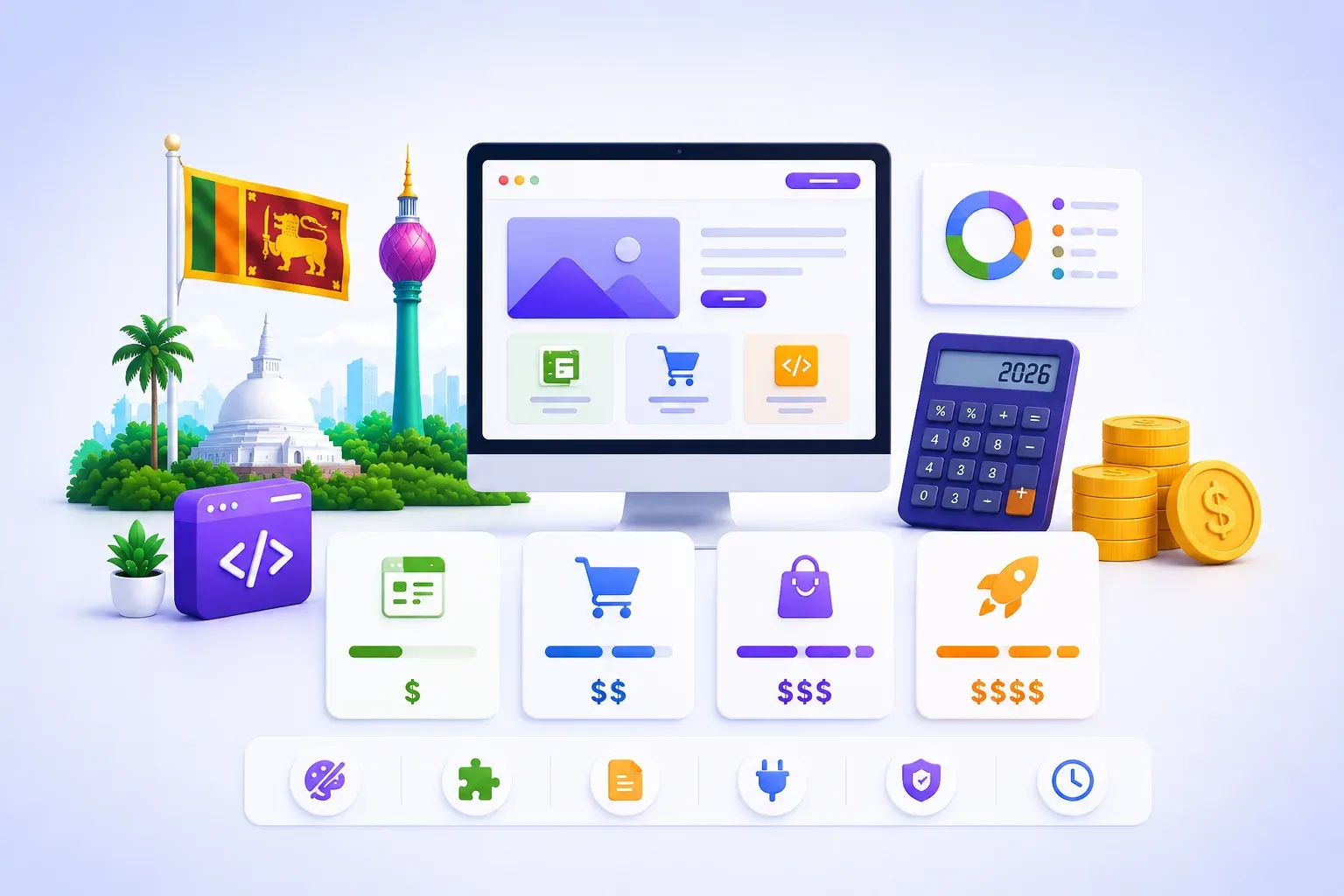
How much does a website cost in Sri Lanka in 2026? Konekt explains our pricing model — starting from LKR 300,000 — and how scope, pages, plugins, and custom development shape your final quote.
Key takeaways
- Konekt's web development projects start from LKR 300,000 — a baseline that covers Business Analysis, Project Management, Engineering, and QA, not just coding.
- Three factors drive the final price: project scope and page count, plugins/integrations required, and how much custom development is involved.
- We estimate cost by breaking scope into tasks, assigning hours per task across BA, design, engineering, and QA, then applying a blended hourly rate.
- A typical 6-8 page corporate website with standard integrations falls in the LKR 300,000-450,000 range.
- A clear sitemap, list of must-have integrations, and examples of sites you like all lead to a tighter, more accurate quote.
If you've searched for "website development cost in Sri Lanka," you've probably found numbers all over the place — from LKR 25,000 for a one-page site to LKR 500,000+ for something custom. Both numbers are real. They're just answers to different questions.
At Konekt, we get asked about pricing on almost every call. This guide explains how we think about web development costs in 2026, what our projects start from, and — more usefully — why two websites that look similar on the surface can cost very different amounts.
Why "How Much Does a Website Cost?" Has No Single Answer
Website pricing in Sri Lanka spans a huge range because "website" covers very different things:
- A template-based landing page assembled in a day or two
- A small business site built on a website builder or basic WordPress theme
- A fully custom-designed corporate or eCommerce site with integrations, custom features, and ongoing support
The first two can reasonably cost as little as LKR 25,000–80,000. But once a project needs proper discovery, custom design, structured content, integrations, testing, and a team that's accountable for the result — the cost structure changes. That's the category most of our clients fall into, and it's what this guide focuses on.
Konekt's Starting Price: From LKR 300,000
Our web development projects start from LKR 300,000. That number isn't a "design fee" — it's the baseline cost of running a project properly, with the four roles every serious build needs:
- Business Analysis (BA) — understanding your business, your audience, and translating "what you want" into a clear scope: pages, content structure, user flows, and functional requirements.
- Project Management (PM) — keeping the timeline, communication, and milestones on track so the project doesn't drift or stall.
- Engineering — the actual design and development work: building pages, components, integrations, and custom functionality.
- Quality Assurance (QA) — testing across devices and browsers, checking forms, links, performance, and responsiveness before launch.
Cheaper quotes you'll see elsewhere often skip BA and QA entirely, and treat PM as something the client does themselves by chasing a freelancer on WhatsApp. That can work for very small sites — but it's also where scope creep, missed bugs, and "it's been three months and it's still not done" tend to come from.
What Determines Your Final Price
Once the LKR 300,000 baseline is covered, three things drive the final number up (or keep it close to the floor):
1. Scope and Number of Pages
More pages and templates mean more design and development hours. A 5-page corporate site (Home, About, Services, Projects, Contact) is a smaller scope than a 15-page site with multiple service sub-pages, an industries section, case studies, and a careers page. We count pages by template type, not just page count — ten blog posts using one template cost far less than ten uniquely designed pages.
2. Plugins, Integrations, and Third-Party Tools
Most sites need more than static pages: contact forms with email/CRM integration, live chat, payment gateways, booking systems, analytics and tag managers, multi-language support, or a CMS so your team can edit content. Each integration adds setup, configuration, and testing time — and some come with their own licensing or subscription costs that we factor into the quote separately from our development fee.
3. Custom Development
This is usually the biggest swing factor. Off-the-shelf themes and plugins can cover a lot of ground cheaply. But the moment you need something that doesn't exist as a plugin — a custom quote calculator, a staff portal, a booking engine tied to your internal systems, a custom API integration with your ERP or POS — that's bespoke engineering. It's estimated and priced on its own, on top of the base website build.
How We Estimate Engineering Effort
Once we have a clear scope, we don't pull a number out of the air — we build the estimate from the ground up:
- Break the scope into a task list — every page, component, integration, and custom feature becomes its own line item.
- Estimate hours per task — based on complexity and our experience delivering similar work, each task gets an hour estimate across BA, design, development, and QA.
- Apply a blended hourly rate — our rate accounts for the mix of seniority involved (BA, PM, developers, QA), not just junior developer time.
- Sum it up — total hours × blended rate gives the engineering cost, which forms the bulk of your quote alongside any third-party licensing costs.
This is why a detailed brief gets you a tighter, more accurate quote. "I want a website like X but for my business" requires us to make assumptions — and assumptions get refined (and priced) once we scope properly.
A Sample Estimate: Corporate Website
To make this concrete, here's a simplified breakdown for a typical 6–8 page corporate website with a CMS, contact form integration, and standard SEO setup — the kind of project that lands near our starting price:
| Work item | Roles involved | Estimated hours |
|---|---|---|
| Discovery & scope definition | BA, PM | 10–15 |
| UI/UX design (homepage + inner page templates) | Design | 25–35 |
| Frontend & CMS development | Engineering | 50–70 |
| Integrations (forms, analytics, basic SEO) | Engineering | 8–12 |
| QA & cross-browser/device testing | QA | 10–15 |
| Project management & client revisions | PM | 10–15 |
Add it up across roles, apply our blended rate, and you land in the LKR 300,000–450,000 range for this type of project. Add eCommerce functionality, multi-language content, custom integrations, or a larger page count, and the estimate scales accordingly — our WooCommerce development and custom-build projects typically start higher because of the additional integration and testing work involved.
Tips for Getting an Accurate Quote
- Have a rough sitemap ready — even a list of page names and a one-line description of each helps us estimate scope quickly.
- List your "must-have" integrations — payment gateways, booking tools, CRMs, or anything you already use that the new site needs to connect to.
- Separate "must-haves" from "nice-to-haves" — this lets us show you a phased approach if your budget is tighter than your wishlist.
- Share examples — sites you like (locally or internationally) help us gauge the design and complexity level you're expecting.
If you'd like a clear, itemised quote for your project, get in touch with Konekt and share your requirements — we'll walk you through scope, timeline, and cost before any work begins.
Frequently asked questions
What is the minimum cost for a website in Sri Lanka in 2026?
Basic template-based sites can start around LKR 25,000–80,000. For a properly scoped, custom-designed business website with BA, PM, engineering, and QA included — the kind most growing businesses need — Konekt's projects start from LKR 300,000.
Why does Konekt's pricing start higher than some local agencies?
Our starting price covers a full project team — business analysis, project management, engineering, and QA — not just a developer's time. This reduces scope creep, catches issues before launch, and means someone is accountable for the timeline and quality of the final site.
Does the quote include hosting and domain costs?
Hosting, domain registration, and any third-party plugin or service licenses (e.g. payment gateways, premium plugins) are typically quoted separately from the development cost, since they're ongoing expenses you'll pay regardless of which agency builds your site.
How long does a typical project take?
A standard corporate website (6–8 pages) usually takes 4–6 weeks from approved scope to launch. Projects with custom development, eCommerce, or multiple integrations take longer, depending on complexity — we'll give you a realistic timeline as part of the quote.
Can I get a phased quote if my budget is limited?
Yes. Once we understand your full scope, we can often phase the build — launching with core pages and essential functionality first, then adding features in a second phase as budget allows.

Dilan Pushpitha
Dilan Pushpitha brings strategic business leadership and digital commerce expertise to Konekt, driving operational excellence, client success, and growth-focused technology solutions. With a strong background in e-commerce, UI/UX, automation, and digital strategy, he helps bridge business needs with practical, scalable digital implementation.