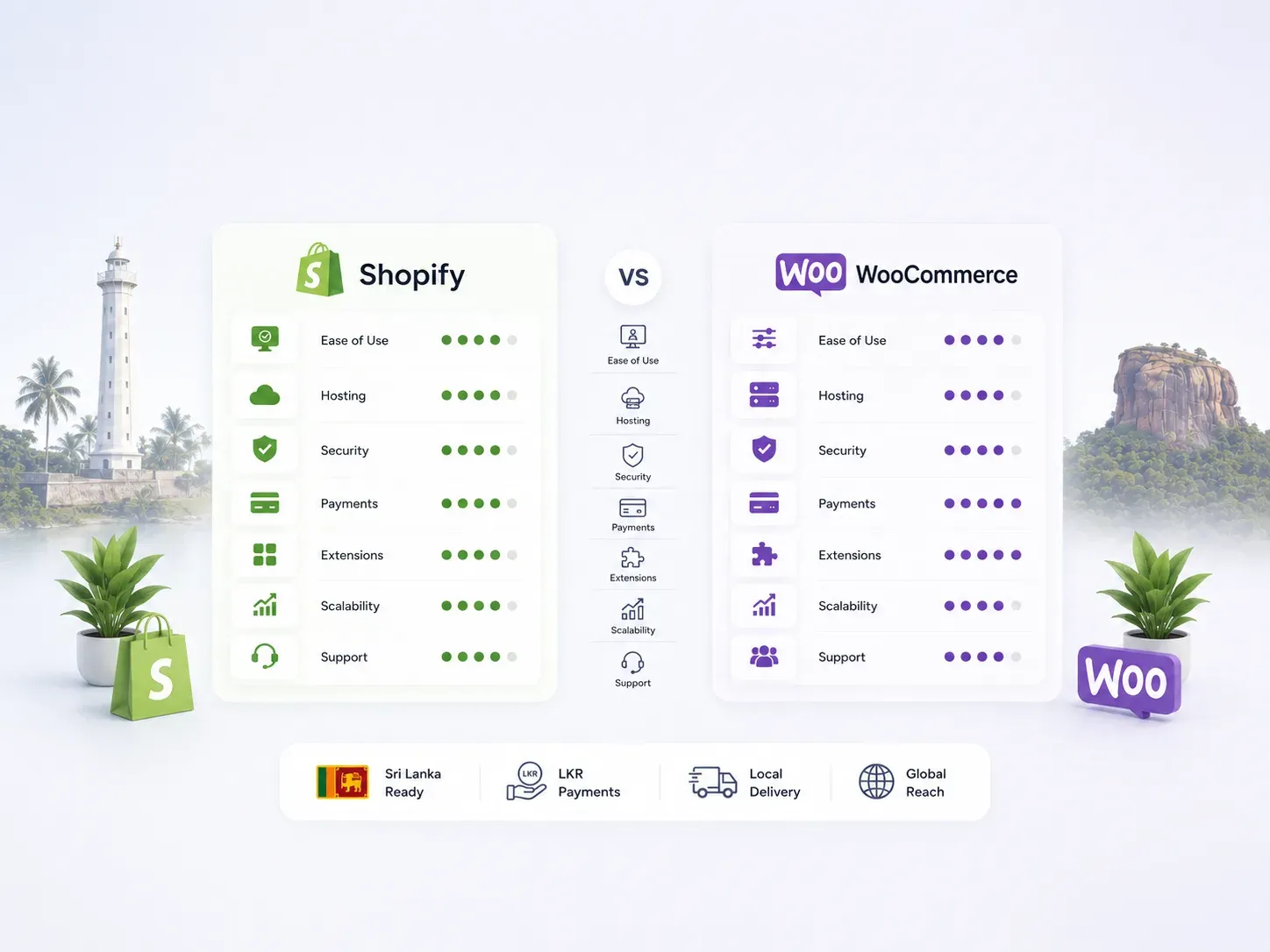
Choosing between Shopify and WooCommerce for your online store? Konekt compares cost, performance, and maintenance, with real examples from our retail and ecommerce projects in Sri Lanka.
Key takeaways
- Shopify is our default recommendation for retail brands that need speed, reliability, and low maintenance — proven on builds like Thilakawardhana and Fashion Bug
- WooCommerce is the better fit for deep customisation, POS/ERP integration, or content-plus-commerce on WordPress — as seen with Gateway College's bookstore
- Shopify costs more in subscription fees but less in ongoing maintenance; WooCommerce is cheaper to run but needs continuous technical upkeep
- Both platforms support Sri Lankan payment gateways like PayHere, Sampath IPG, and DirectPay when configured correctly
- Konekt builds and supports both platforms in-house, so our recommendation is based on your business model, not platform hype
If you're planning an online store, the platform decision usually comes down to two names: Shopify and WooCommerce. Both can power a successful Sri Lankan ecommerce business — but they're built on very different foundations, and the right choice depends on what your business actually needs.
At Konekt, we've built and maintained stores on both platforms for clients across retail, fashion, education, and trading. This guide breaks down the real differences and shares our honest recommendation, based on the projects we've delivered.
Shopify vs WooCommerce at a Glance
| Shopify | WooCommerce | |
|---|---|---|
| Type | Hosted SaaS platform | Free plugin for WordPress |
| Hosting | Included, managed by Shopify | You choose and manage your own hosting |
| Setup speed | Fast — store can launch in days | Slower — depends on hosting, theme, and plugins |
| Performance | Fast out of the box, global CDN | Depends on hosting and optimisation |
| Customisation | Theme + app ecosystem, Shopify Functions for advanced logic | Full code-level control via WordPress |
| Maintenance | Low — Shopify handles security and updates | Higher — updates, backups, and security need ongoing management |
| Best for | Retail brands, fast-growing stores, low-maintenance operations | Businesses needing deep customisation, content + commerce, or POS/ERP integration |
What Is Shopify?
Shopify is a fully hosted ecommerce platform. You pay a monthly subscription, and Shopify takes care of hosting, security, PCI compliance, and infrastructure. Stores are built on Shopify's theme system (using Liquid) and extended through its app ecosystem — covering everything from email marketing to inventory management to loyalty programs.
Because Shopify is a managed platform, store owners don't need to think about servers, SSL certificates, or software updates. Pages load fast by default thanks to Shopify's global CDN, and checkout is built in and optimised for conversion.
What Is WooCommerce?
WooCommerce is a free, open-source plugin that turns a WordPress website into an online store. Because it's built on WordPress, WooCommerce gives store owners full control over code, design, and functionality — but that control comes with responsibility. You, or your development partner, choose the hosting, manage updates, and handle security.
WooCommerce is a natural fit for businesses that already run on WordPress, or that need ecommerce to sit alongside a content-heavy website — a school with a blog and an online bookstore, for example, or a company site with a small product catalogue.
Key Differences That Matter for Sri Lankan Businesses
Cost
Shopify's subscription fees are predictable: you know your monthly cost upfront, and it scales with your plan. WooCommerce's core software is free, but total cost depends on hosting, premium plugins, and developer support. It can be cheaper at small scale, but costs can creep up as a store grows.
Performance and reliability
Shopify is built on globally distributed infrastructure, so a customer browsing from Colombo or London is served from a nearby server automatically. WooCommerce performance depends entirely on your hosting and how well the site is optimised — a well-built WooCommerce store can be very fast, but it takes deliberate work to get there and stay there.
Maintenance
This is often the deciding factor. Shopify handles platform updates, security patches, and uptime. With WooCommerce, WordPress core, the WooCommerce plugin, your theme, and every extension need to be kept updated and compatible — and someone needs to own that on an ongoing basis.
Customisation and integrations
WooCommerce wins on raw flexibility — if it can be coded, it can be built. Shopify covers most needs through its app ecosystem and, for more advanced requirements, Shopify Functions and checkout extensibility. For businesses that need to integrate with a specific local POS, ERP, or legacy system, WooCommerce's open architecture often makes custom integration more straightforward.
Local payment gateways
Both platforms support Sri Lankan payment gateways — PayHere, Sampath IPG, DirectPay, and others — when configured correctly. This isn't a differentiator on its own, but it's worth confirming with your development partner regardless of platform.
When We Recommend Shopify
For most retail brands, Shopify is our default recommendation — it's the platform we steer fashion, lifestyle, and product-led businesses toward unless there's a specific reason not to.
Why: retail brands need to launch fast, scale during peak seasons such as Avurudu or Christmas sales spikes, and run promotions without worrying about server load or plugin conflicts. Shopify's built-in performance, security, and checkout experience let the business focus on merchandising and marketing rather than infrastructure.
Two examples from our own work:
- Thilakawardhana — we rebuilt their ecommerce platform on Shopify to improve user experience, conversion rates, and operational efficiency, including delivery and loyalty management integrations.
- Fashion Bug — one of Sri Lanka's largest fashion retail chains runs its online store on Shopify, supporting a large product catalogue across multiple categories with island-wide delivery.
If you're a retail brand evaluating platforms, Shopify is very likely the right starting point.
When We Recommend WooCommerce
WooCommerce earns its place when a business needs something Shopify can't easily provide out of the box — usually deep integration with an existing system, or a website where content and commerce need to live together on WordPress.
Examples from our work:
- Gateway College — we built a WooCommerce bookstore integrated in real time with the school's existing MyPOS system, enforcing grade-level book lists and syncing every order back to the counter.
- Samson Trading, Insomnia, and Refind all run on WooCommerce, where the business needed the flexibility of a WordPress-based platform alongside an online store.
If your business already runs on WordPress, needs to integrate with a specific local system, or has requirements that don't fit neatly into Shopify's app ecosystem, WooCommerce is worth a serious look.
Our Recommendation for Retail Brands
If you're a retail brand — fashion, lifestyle, FMCG, or general merchandise — and you're choosing a platform from scratch, we recommend Shopify in most cases. It gets you to market faster, performs reliably under load, and removes the maintenance burden that often catches growing businesses off guard on WooCommerce.
WooCommerce remains the right choice when your business has a specific integration requirement, an existing WordPress investment, or a content-plus-commerce model — and in those cases, it can be just as effective as Shopify.
The honest answer is that there's no universally "better" platform — only the platform that fits your business model, technical requirements, and growth plans.
Can You Switch Platforms Later?
Yes. We've helped businesses migrate in both directions — from outdated platforms to Shopify, and from Shopify or other systems to WooCommerce, depending on what the business needed. A migration done properly preserves SEO rankings through redirect maps, carried-over structured data, and sitemap resubmission, along with product and order history — so the platform you choose today doesn't have to be permanent.
Why Build With Konekt
Konekt is a Certified Shopify Partner and has also delivered WooCommerce projects for schools, trading companies, and retail brands across Sri Lanka. Because we work hands-on with both platforms — not just one — our recommendation is based on what fits your business, not which platform we're locked into selling.
Our team handles design, development, integrations (PayHere, Sampath IPG, DirectPay, MyPOS, couriers, ERPs), SEO, and post-launch support in-house for both Shopify and WooCommerce builds.
If you're weighing up Shopify vs WooCommerce for your business, contact us for a free consultation. We'll give you a straight answer based on your specific requirements, not a sales pitch for one platform.
Frequently Asked Questions
Is Shopify or WooCommerce better for a small business in Sri Lanka?
It depends on the business. A retail brand selling products will usually do better on Shopify due to lower maintenance and faster setup. A business that needs to integrate ecommerce with an existing WordPress site, or with a specific local system, may be better served by WooCommerce.
Is Shopify more expensive than WooCommerce?
Shopify has a predictable monthly subscription cost. WooCommerce's core software is free, but hosting, premium plugins, and ongoing maintenance can add up — sometimes to a similar or higher total cost over time, especially if performance and security aren't actively managed.
Can WooCommerce integrate with a POS system in Sri Lanka?
Yes. We've built WooCommerce stores that integrate in real time with POS systems like MyPOS — for example, our project for Gateway College, where online orders sync directly with the school's existing point-of-sale system.
Does Konekt build on both Shopify and WooCommerce?
Yes. Konekt is a Certified Shopify Partner and also builds and maintains WooCommerce stores. We work with whichever platform best fits the client's business model and technical requirements.
Which platform is better for SEO?
Both platforms can rank well when built correctly. WooCommerce, running on WordPress, offers more granular control over technical SEO out of the box. Shopify has improved significantly on SEO flexibility and offers strong default performance, which is itself an SEO factor. The bigger factor in both cases is how the site is built and maintained.
How long does it take to launch a Shopify or WooCommerce store?
A standard Shopify store typically launches in 4 to 6 weeks. A WooCommerce store takes a similar timeframe for standard builds, with more complex integrations — like POS or ERP connections — extending the timeline to 8 to 10 weeks.

Dilan Pushpitha
Dilan Pushpitha brings strategic business leadership and digital commerce expertise to Konekt, driving operational excellence, client success, and growth-focused technology solutions. With a strong background in e-commerce, UI/UX, automation, and digital strategy, he helps bridge business needs with practical, scalable digital implementation.